How to build an agile product roadmap that stays accurate as plans change
Most EPD teams know the feeling: you publish a roadmap, share it in three different tools, and within a week, it's already out of date. Stakeholders treat it like a contract, engineers know it isn't real, and you spend more time explaining changes than making good decisions.
An agile product roadmap offers a different pattern. Instead of a static list of features and dates, you get a living view of strategic bets and outcomes. It gives teams direction, but still leaves room for responding to customer feedback, engineering discoveries, and market shifts.
That works best when your agile product roadmap lives in a connected product development workspace alongside strategy docs, research, tasks, and retros. When context travels with the roadmap, everyone can see not just what's planned, but why.
What is an agile product roadmap?
An is a shared, always-current view of where you're headed and why. This type of roadmap focuses on outcomes and rather than specific functionality or fixed feature checklists with hard delivery dates. As you learn more from customers and engineering, you adjust the plan while still keeping everyone aligned on the underlying business goals.
Agile product roadmap vs. product backlog vs. release plan
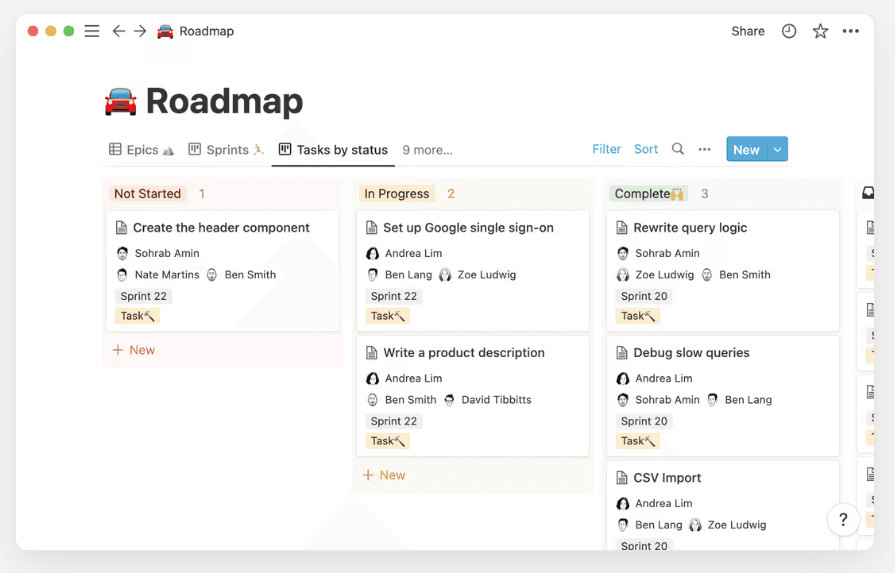
A Notion product roadmap showing tasks by status: not started, in progress, and complete (Source)
These three pieces of the product puzzle serve different purposes and audiences:
Agile product roadmap: Shows strategic direction and intent. It highlights the problems you're solving, the outcomes you're chasing, and when you'll focus on each area—often grouped into "Now/Next/Later" or quarterly timeframes. It's written for a broad audience: product, engineering, design, leadership, and go-to-market teams.
Product backlog: Your execution queue. It's the ordered list of user stories, spikes, bugs, and technical work your development team pulls from. It's detailed, tactical, and changes frequently as work ships and new learning arrives.
Release plan: Sits in between. It maps specific capabilities to key milestones and launch windows so you can coordinate dependencies and go-to-market activities. It's more concrete than a roadmap but still open to adjustment as discovery and implementation evolve.
When these three live in separate tools, they drift. Stakeholders interpret roadmap themes as promises, engineers treat release plans as deadlines, and you end up defending changes instead of discussing trade-offs. Connecting all three in one workspace helps updates flow both ways: discovery work in the backlog influences the roadmap, and roadmap shifts automatically inform release planning.
For teams managing work across multiple initiatives, a project roadmap can complement this setup by allowing you to track progress at a higher level.
Why do teams use an agile product roadmap?
EPD teams adopt agile product roadmaps to solve a real coordination problem: strategy, discovery, and delivery live in different places, and nobody has the full picture. That fragmentation leads to slow decision-making, conflicting priorities, and insights no one fully trusts. According to Digital.ai's 18th State of Agile Report, 53% of organizations struggle to prioritize work because their insights are unreliable.
A well-run agile product roadmap gives you a single, outcome-focused view that ties all that work together. It allows you to:
Align on outcomes and trade-offs without overcommitting to scope: Traditional roadmaps lock you into scope before you understand the problem, forcing you to defend dates instead of objectives. An agile product roadmap flips that, aligning you around outcomes like activation or retention and treating features as hypotheses you can adjust as you learn.
Build a shared narrative that reduces reactive roadmap churn: Stakeholders usually lack context about why something is prioritized or how a new request affects existing bets. When your roadmap links back to strategy, customer insights, and success metrics in a shared workspace, stakeholders can self-serve the "why" instead of pinging PMs for explanations.
Get clear decision context for sequencing work across teams: When multiple teams are involved, sequencing becomes fragile—teams collide, wait on each other, or ship in risky order. An agile product roadmap makes dependencies, ownership, and risks explicit, so you can sequence work intelligently instead of relying on hallway conversations.
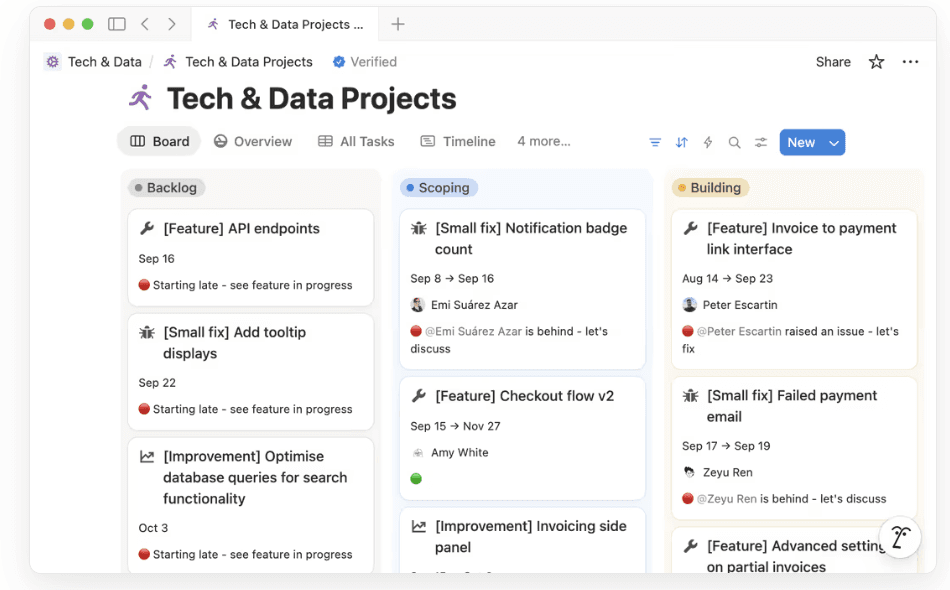
A Kanban similar to the one used by Qonto that shows projects in the backlog alongside those teams are scoping and building (Source)
For example, Ramp uses Notion to keep strategy, discovery, and delivery connected during massive product launches. Even when plans change, their teams stay aligned. With more work centralized and connected, teams spent less time hunting for context and more time making decisions.
What should an agile product roadmap include for better cross-team alignment?
The benefits of agile roadmaps only land if you include the right elements. Here's what to build in for better team alignment:
Outcome-based themes and strategic bets connected to product strategy
Organize your roadmap around outcomes, not features. Instead of "Build advanced search," you might have a theme like "Help users find relevant content faster." Under each theme, define a small set of strategic bets—concrete approaches you'll try to move the outcome.
In Notion, you can link those themes and bets to strategy docs, competitive analysis, and customer research, giving everyone a clear line of sight from the roadmap to the broader product narrative.
OKRs, success metrics, and confidence levels to balance flexibility with accountability
Pair each theme or bet with OKRs or clear success metrics—for example, "Increase 30-day activation from 40 percent to 55 percent." Add a simple confidence level (high/medium/low) for the time horizon or impact.
This makes uncertainty explicit: a low-confidence "Later" bet tells stakeholders you're still exploring, while a high-confidence "Now" theme signals a firmer commitment.
Time horizons and the level of detail to use in each
A simple "Now/Next/Later" structure works well:
Now: Work in progress or about to start, with clear scope, owners, and success metrics
Next: Validated themes you expect to tackle soon, with directional scope and known risks
Later: Longer-term opportunities expressed as problem spaces and outcomes, not specs
The closer something is to "Now," the more detail you share and the tighter the connection to your backlog and project boards. Further out, keep things intentionally high-level so you can absorb new information without renumbering every item.
Ownership, risks, and dependencies that matter for cross-functional execution
Make it clear who's accountable and what could get in the way—cross-team dependencies, external constraints like compliance reviews, and major known risks.
In Notion, you can represent these as properties—"Owner," "Blocking dependency," "Key risk"—and link each roadmap item to related projects or docs. When priorities shift, everyone sees the downstream impact.
How do you create an agile product roadmap step by step?
Building an agile product roadmap is about connecting strategy, customer insights, and team capacity into a shared view everyone can trust.
Here's a practical framework built for adaptability that you can tailor to your team's workflow, with tips to streamline the process:
Step 1: Translate product strategy into goals and guardrails
Turn your product strategy into a small set of concrete goals for the next 1–2 quarters, aligned with company OKRs. Then define guardrails: constraints and principles that help you say no—technical limits, capacity realities, or stances like "optimize for existing customers before expanding into a new segment."
Keeping your product vision, strategic objectives, and guardrails in linked Notion pages makes it easy to trace roadmap items back to the decisions that informed them.
Step 2: Synthesize customer insights and delivery learnings into themes and bets
Gather what you're learning from customers and delivery: user research, product analytics, support conversations, sales feedback, and engineering retrospectives. You're looking for patterns that map to customer needs and your goals, not one-off anecdotes.
In Notion, you can relate research notes, feedback databases, and incident reports to potential roadmap themes. As connections emerge—such as repeated onboarding friction across research sessions and support tickets—turn those into outcome-based themes and a shortlist of corresponding bets.
Notion's Custom Agents can automate this synthesis. For example, you can prompt your agent to analyze customer feedback from Slack, Notion, and email, and produce themes with citations back to each source so patterns surface faster.
Step 3: Prioritize with a lightweight model and capacity and dependency checks
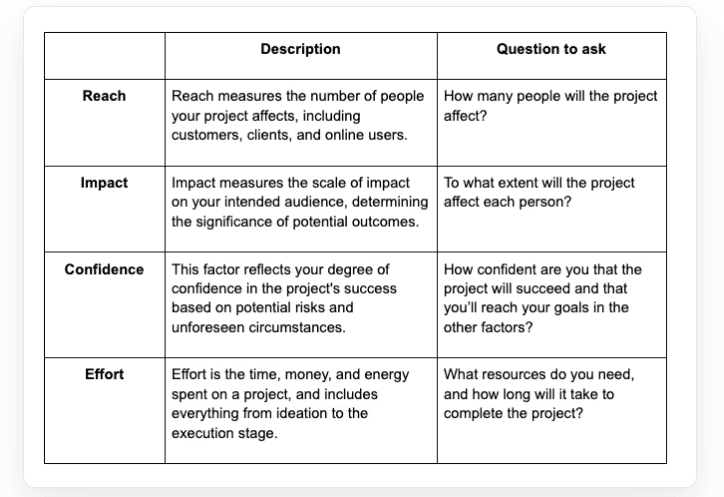
A table with the RICE (Reach, Impact, Confidence, Effort) framework, including descriptions of criteria and questions to ask (Source)
Choose a simple prioritization model your team understands—impact vs. effort, RICE, or a custom score—and apply it consistently. Then ground that ranking in reality: check which teams are involved, what dependencies exist, and how much capacity you actually have.
In a Notion database, you can add effort estimates, owning teams, and dependency links, then sort and filter to highlight collisions before they become problems.
Step 4: Map themes to time horizons and validate with key stakeholders
Group themes into time horizons and link near-term themes directly to epics or projects in your execution tools. Notion's product roadmap template gives you a ready-made structure to start from.
Share the draft with engineering, design, and key stakeholders to build buy-in before you publish. Because they can see the roadmap alongside strategy docs and research in Notion, feedback tends to focus on trade-offs, not personal preferences.
Step 5: Publish the roadmap narrative and define how to maintain it
Publish your agile product roadmap as a narrative plus a —not just a static slide. Explain the goals, the big themes, what you're not doing yet, and how teams should read each time horizon. Decide who owns updates, how often you'll review the roadmap, and what events should trigger a change.
How do you manage an agile product roadmap as plans change?
The hardest part of an agile product roadmap isn't building it. It's keeping it trustworthy as plans evolve. According to ProductPlan's 2025 State of Product Management report, nearly half of product managers cite lack of visibility and data silos as a key reason to consolidate tools, which means the problem doesn't go away once you build the roadmap.
Managing change well requires an iterative approach—one that covers governance, triggers, clear communication, and lightweight alignment. A connected workspace and tools like Notion AI can lower the coordination cost and support continuous improvement by pulling updates from tasks, docs, and notes into concise summaries you can share.
Set roadmap governance
Decide who’s responsible for the roadmap and establish systems that keep it aligned as work evolves. A product manager typically owns the overall artifact, while engineering and design leaders contribute delivery signals and discovery insights. Custom Agents can help enforce roadmap adherence by monitoring execution and flagging when projects drift from strategic themes—prompting downstream adjustments before misalignment grows.
Agree on a cadence—monthly or aligned to your strategic planning cycle—for reviewing themes, time horizons, and confidence levels. To keep the process efficient, use AI Meeting Notes to automatically capture discussions and document decision-making. These summaries create a reliable record of tradeoffs, assumptions, and rationale, and can be linked to a central decision log so everyone can see what changed and why.
Define update triggers
Make it explicit what should cause you to revisit the roadmap: discovery that invalidates a key assumption, delivery signals like recurring blockers or major scope shifts, and strategy changes from leadership or the market.
Documenting these triggers in the same place as your roadmap gives product teams permission to propose updates when they see those signals, keeping the roadmap responsive without turning every piece of feedback into churn.
Communicate changes with clarity
When you adjust the roadmap, lead with what's changing in terms of goals and themes—"shifting emphasis from new feature X to reliability for existing users"—and connect that back to the underlying data or events.
Because your roadmap, research, and project docs live together in Notion, you can link directly to user feedback, analytics reports, or . Notion AI can summarize what changed so you're not rewriting the story from scratch every time priorities move.
Keep stakeholders aligned
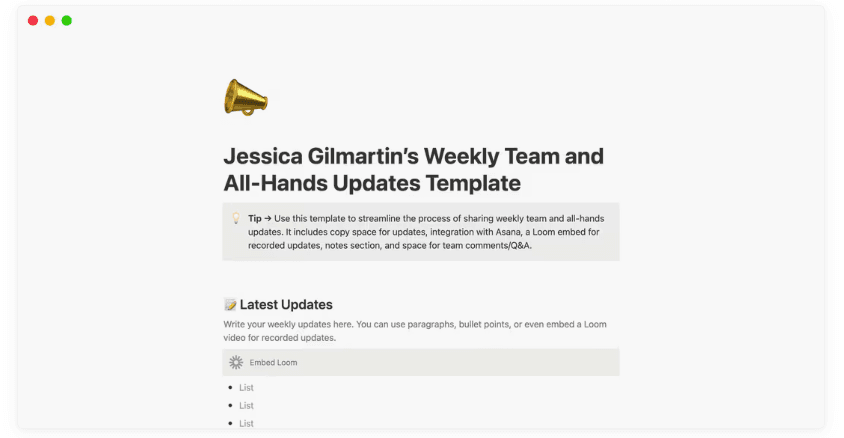
A template by Jessica Gillmarting for sharing weekly team and all-hands updates with async stakeholders (Source)
Give different stakeholders the views they need, all tied to the same source of truth. Leadership might care most about themes and outcomes by quarter. Sales may want high-level timelines and launch windows. Engineering leads often focus on dependencies and capacity.
In Notion, you can create tailored roadmap views for each group and use AI-generated summaries for async updates. Clear escalation rules—who approves scope, budget, or timing changes—round out the system so you stay flexible without inviting constant re-prioritization.
Bring your agile product roadmap to life with Notion AI
An agile product roadmap works best as a living guide, not a static promise. It connects your strategy to discovery and delivery, highlights the outcomes you care about, and gives teams the context they need to make smart decisions as they learn.
When you keep that roadmap, your OKRs, customer insights, and engineering work together in Notion, roadmap items can reference research and feedback, link to active projects, and stay aligned with the latest plans. Notion AI can summarize what's changed and surface emerging risks or patterns so you spend less time chasing updates and more time shaping the product.