What is agile product management? Tips for better project alignment
Most EPD teams aren't failing at agile. They're practicing it across too many disconnected tools. Product strategy lives somewhere different from the sprint board, discovery notes don't connect to roadmap decisions, and context gets rebuilt from scratch every planning cycle.
Agile product management addresses this by treating strategy, discovery, and delivery as a single connected system rather than sequential handoffs. Increments are still small, but each one is tied to a clear outcome, informed by ongoing learning, and visible to everyone working on the product.
What is agile product management?
Agile product management builds on the core principles of the Agile Manifesto, which established agile methodologies favoring working software, customer collaboration, and responding to change over rigid planning.
It combines agile practices with continuous discovery and outcome-focused product strategy, treating every planning cycle, sprint, and release as part of a learning system, not a one-time push to clear a backlog.
Unlike traditional product management, this approach assumes your understanding of customers will change. You still set a direction, but you express it as outcomes and hypotheses, then refine it based on what you learn from real usage, research, and the market.
Agile product management vs. agile project management
While both management types share the same methods, they optimize for very different outcomes.
Here’s how they compare:
Agile project management is about delivering a defined scope on time and on budget. You measure success with story points, throughput, and predictability, which is useful, but doesn't tell you whether the features you shipped made any real difference for customers or the business.
Agile product management moves the focus to outcomes. Instead of asking whether you finished the sprint, you ask whether your work reduced onboarding drop-off, improved retention, or unlocked revenue. Strategy, discovery, and delivery run as connected loops rather than separate phases, with the roadmap adjusting based on what you learn.
To understand how they differ in practice, consider two teams: one tracks sprints and tasks, hits velocity targets, but can't show which features moved activation or revenue. The other connects roadmap items to outcomes and metrics, reviews learnings each week, and shifts priorities when data contradicts assumptions. Both teams are busy, but the second one has more to show for it.
What problems does agile product management solve for EPD teams?
Most EPD teams struggle with , constant re-prioritization, and roadmaps that don't reflect real customer needs. According to the , improving alignment and collaboration remains the top challenge for agile teams year over year.
Agile product management addresses this by connecting goals, experiments, and delivery work in a shared workspace.
Improves cross-functional alignment
Cross-functional alignment gets easier when cross-functional teams across product, engineering, and design share a single source of truth for goals, roadmaps, and decisions.
Tradeoffs happen in the open: the product owner can show which outcome a feature supports, engineers can surface technical debt early, and designers can reference past research. You spend less time rehashing decisions and more time moving forward on what you actually know.
Reduces waste by validating assumptions earlier
A lot of waste comes from building on untested assumptions. Agile product management bakes validation into normal cycles by capturing user stories and hypotheses, running small experiments, and tracking evidence in the same place you manage your roadmap.
That way you can cut weak ideas after a prototype test rather than after a full build, and invest more in what shows real signal.
Increases speed without sacrificing quality
Speed in agile product management comes from shortening feedback loops, not from pushing teams harder. When context, research, and constraints are visible in one workspace, you make faster decisions with less guesswork and fewer status meetings. That's also tools that compress the time between gathering insight and acting on it.
McKinsey's 2025 State of AI survey found that 88% of organizations now regularly use AI in at least one business function, up from 78% the year prior, and that revenue gains are most commonly reported in product and service development.
For EPD teams, that signals a clear shift toward AI-driven product development as a competitive differentiator.
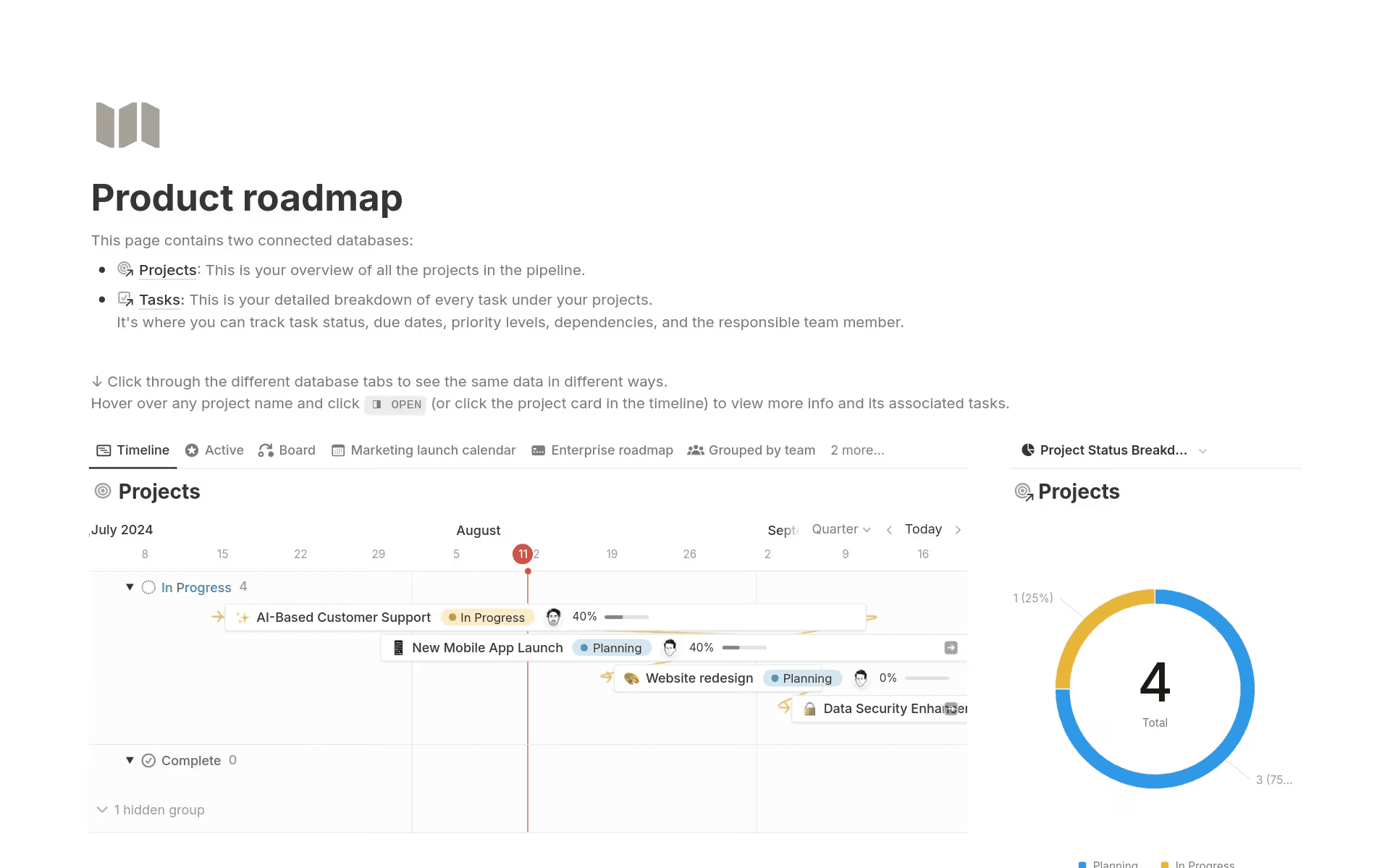
A Notion product roadmap template with a timeline view of in-progress projects alongside a project status breakdown chart showing planning and in-progress totals. (Source)
How do teams organize for agile product management?
Agile product management depends as much on how you organize your teams as on how you run your sprints.
Most high-functioning EPD teams form stable, cross-functional teams around products or domains. Each team has clear ownership, decision rights, and just enough governance to stay aligned, a structure that also underpins good .
How to define product leadership roles and ownership
Role clarity gives your development team room to move fast without stepping on each other:
Product leaders own the problem space: defining outcomes, shaping the product roadmap, and making sure the team understands customer needs.
Engineering leaders own how you solve those problems: architecture, technical quality, and delivery health.
Design leaders own the experience: usability, interaction patterns, and the insights coming from research.
The scrum master or equivalent role keeps the agile process on track, removing blockers and protecting the team’s focus.
Document where these responsibilities intersect: who decides when to cut scope, who has final say on design tradeoffs, and how technical risks influence priorities. Explicit agreements here keep collaboration and teamwork from running on assumptions.
How to set decision rights and guardrails
Clear decision rights tell your teams which calls they can make on their own and which need broader input. Start by listing the key decision types in your product work:
Outcome selection: Who decides which customer problems to solve next
Roadmap prioritization: Who makes the final call on sequencing
Architecture choices: Who owns technical direction and tradeoffs
UX direction: Who decides on interaction patterns and design changes
Experiment approvals: Who greenlights tests and prototypes
Incident responses: Who can make emergency calls
For each decision type, assign an owner and any required collaborators, plus simple criteria for when escalation makes sense. Then add guardrails like technical standards, compliance requirements, brand guidelines, and budget limits to keep teams moving fast within known boundaries.
When this information lives next to your roadmaps and product backlog, and not buried in a policy doc, teams can make confident decisions without constant check-ins. Keeping stakeholders informed at this level also reduces the overhead of approval cycles.
How to run an operating cadence that supports learning
The operating cadence is where agile product management comes alive or falls apart. A simple rhythm works best: sprint planning to choose outcomes and bets, mid-cycle check-ins to adjust based on what you’re learning, daily standups to surface blockers early, demos to gather feedback, and retrospectives to improve how you work.
The key is capturing decisions and insights from each of these moments in the same workspace where you track work, so hard-won learnings become part of how your team plans, designs, and ships, much like to every cycle.
What does an agile product management workflow look like from strategy to delivery?
In a healthy agile product development workflow, vision, discovery, and delivery form a continuous loop. You set outcomes, explore opportunities, prioritize bets, ship changes, and then learn from what really happened, using that learning to refine what you do next.
Align on product vision, outcomes, and constraints
The workflow starts by being explicit about where you’re trying to go and what might limit your options. That usually means writing down a short vision for the product area, a small set of measurable outcomes tied to your KPIs, and the technical, regulatory, or business constraints that matter.
Capture this in a central, living or database that your EPD team actually uses. Connect it to OKRs, customer problem statements, and any relevant market context. When this context is visible alongside roadmaps and backlogs, you spend less time re-explaining the strategy and more time making concrete tradeoffs within it.
Run continuous discovery and prioritization
Continuous learning sits at the heart of agile product management. Instead of treating discovery as a phase you check off, weave it into your team’s week: talking with customer-centric research, reviewing analytics, scanning support tickets. Then turn those inputs into a structured backlog of opportunities, hypotheses, and evidence.

Helpful Resource
Teams can automate part of this synthesis with Notion Custom Agents. Agents can review customer interview notes, support tickets, and analytics dashboards each week, highlighting recurring problems or feature requests and suggesting backlog opportunities.
Instead of manually stitching insights together, product teams start discovery discussions with patterns already surfaced.
By keeping discovery artifacts in the same workspace as your product roadmap and sprint board, anyone on the team can trace a backlog item back to the research or data that shaped it, making it obvious why priorities shift.
Execute iterative delivery and learning loops
Delivery is where hypotheses meet real users. Agile product management encourages you to release in small slices so you can observe outcomes quickly and adapt.
Attach every change to an outcome: For each slice, define what you expect to see in behavior or metrics.
Capture what actually happened: After release, record the data, user feedback, and operational functionality metrics next to the work item.
Feed the results into planning: Use retrospectives and planning sessions to adjust the roadmap based on what you learned.
Helpful Resource
Use a Custom Agent to automatically maintain feedback loops. Agents can monitor project updates, analytics dashboards, and experiment logs, then summarize results for the team after each release—linking outcomes directly to the roadmap item or hypothesis that triggered the work.
When you link each shipped change back to its original hypothesis and outcome, you build a clear memory of what worked and what didn't. This makes the next round of decisions faster and more grounded.

A Notion roadmap board with tasks grouped by status, showing assignees, sprint tags, and task types. (Source)
Which agile product management practices drive alignment and speed?
Three practices in particular, outcome-based roadmaps, lean backlog management, and focused measurement, tend to have an outsized impact on alignment and speed across agile frameworks.
1. Outcome-based roadmaps
Outcome-based roadmaps optimize your plan around changes you want to see in customer or business metrics, not around a long list of features. You describe problems and target outcomes first, then leave room for the team to discover and iterate on the best solutions.
A simple “Now / Next / Later” format works well as a project roadmap structure, keeping the plan light enough to update as you learn and flexible enough to accommodate shifting timelines and business objectives:
"Now" holds the bets you're currently executing against specific outcomes
"Next" contains opportunities you've validated and are preparing to tackle
"Later" captures ideas that need more discovery
Because this structure is lighter than a date-based feature roadmap, you can update it quickly as you learn.
The real value comes when that roadmap lives next to your discovery notes, experiment logs, and delivery boards. Anyone on the team can see:
How a particular sprint ties back to an outcome
Which evidence led you there
What might change if new information appears
Lean backlog management
A lean backlog is one you can actually act on. Instead of hundreds of stale tickets, you maintain a focused set of well-shaped items that reflect your current thinking about the product.
In practice, that means:
Keeping only the next couple of cycles detailed at the story level, with everything further out captured as broader opportunities or hypotheses
Defining simple “ready” and “done” criteria so work doesn't start half-baked or finish without clear acceptance
Refining items just in time with the latest insights, since the backlog sits close to your roadmap and discovery work
Measuring what matters
Measurement in agile product management is about focus, not volume. Keep it simple:
Start with outcome metrics: A handful of OKRs that reflect customer value and business results
Add product analytics: Data that shows how people actually use your features
Track delivery health: A few metrics like cycle time or deployment frequency to reveal friction in your process
Keep these metrics visible where the work happens, linked from roadmap items, embedded near sprint boards, referenced in planning docs. You’ll spend less time assembling reports and more time using shared data to guide decisions about what to build next.

Helpful Tip
Go a step further by using a Custom Agent to automatically generate updates. Ask an Agent to compile weekly summaries from sprint boards, analytics dashboards, and meeting notes, and produce a concise product update for leadership—all without involving a product manager.
Bring agile product management to life in a connected workspace
Agile product management works when strategy, discovery, and delivery connect in continuous improvement loops, not when they’re scattered across slides, docs, and trackers. Whether you’re part of a large enterprise, a startup, or anything in between, the principles hold.
Bring your outcomes, roadmaps, research, and sprint work into one shared workspace like . Document what you want to achieve, link roadmap items to the evidence behind them, and use simple templates for experiments and backlogs so every cycle builds on what you learned before.
Try Notion AI to see how a connected workspace helps successful product teams practice agile product management by linking outcomes, discovery, and delivery in one place.