Monumental Labs Uses Custom Agents to Move from Estimate to Proposal in Minutes
Monumental Labs is reviving the ancient craft of stone carving—robots mill the stone at scale, and artists finish every piece by hand. That's also how they run the company. In their Notion workspace, Custom Agents do the repeatable work of turning an estimate into a client-ready proposal, and the sales team builds the relationship and closes the deal. Same principle, different material: automate the labor, protect the craft.
The bottleneck wasn’t the factory, but the business process
In the factory, Monumental Labs has embraced automation—robots, tool paths, and tightly engineered systems that make fabricating beautiful sculpture efficient.
But on the business side, critical business processes like client proposals were still built the old way: someone had to gather scope, requirements, and estimates from different places before anything could go to a client. As founder and CEO Micah Springut puts it, “the part we hadn’t automated until we were using Notion is: How do we get all this information into the hands of clients very quickly?”
That work became a real constraint. “Especially as we’re preparing to basically 5× to 10× production in the next few months…it was just a massive bottleneck,” Micah says.
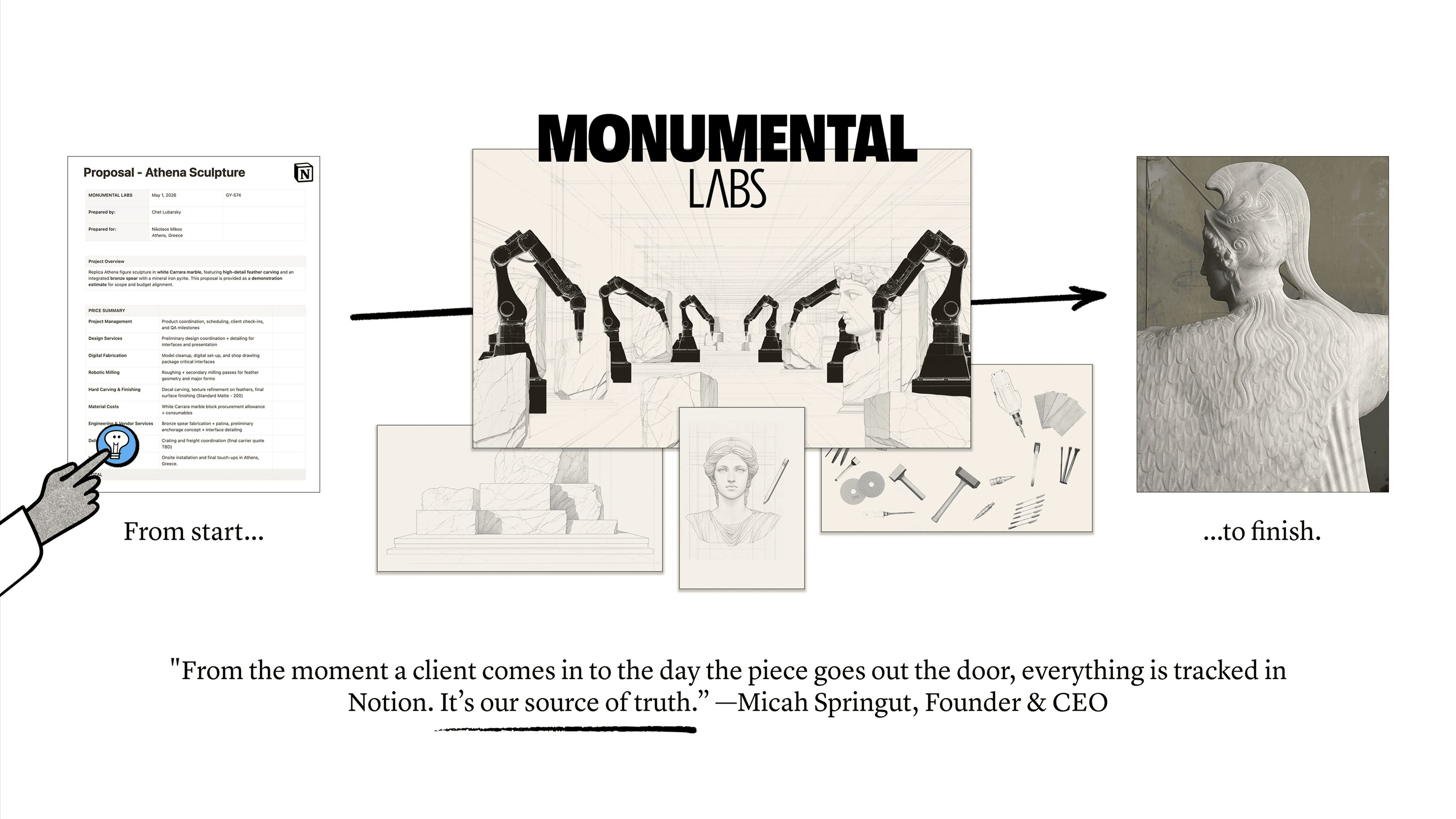
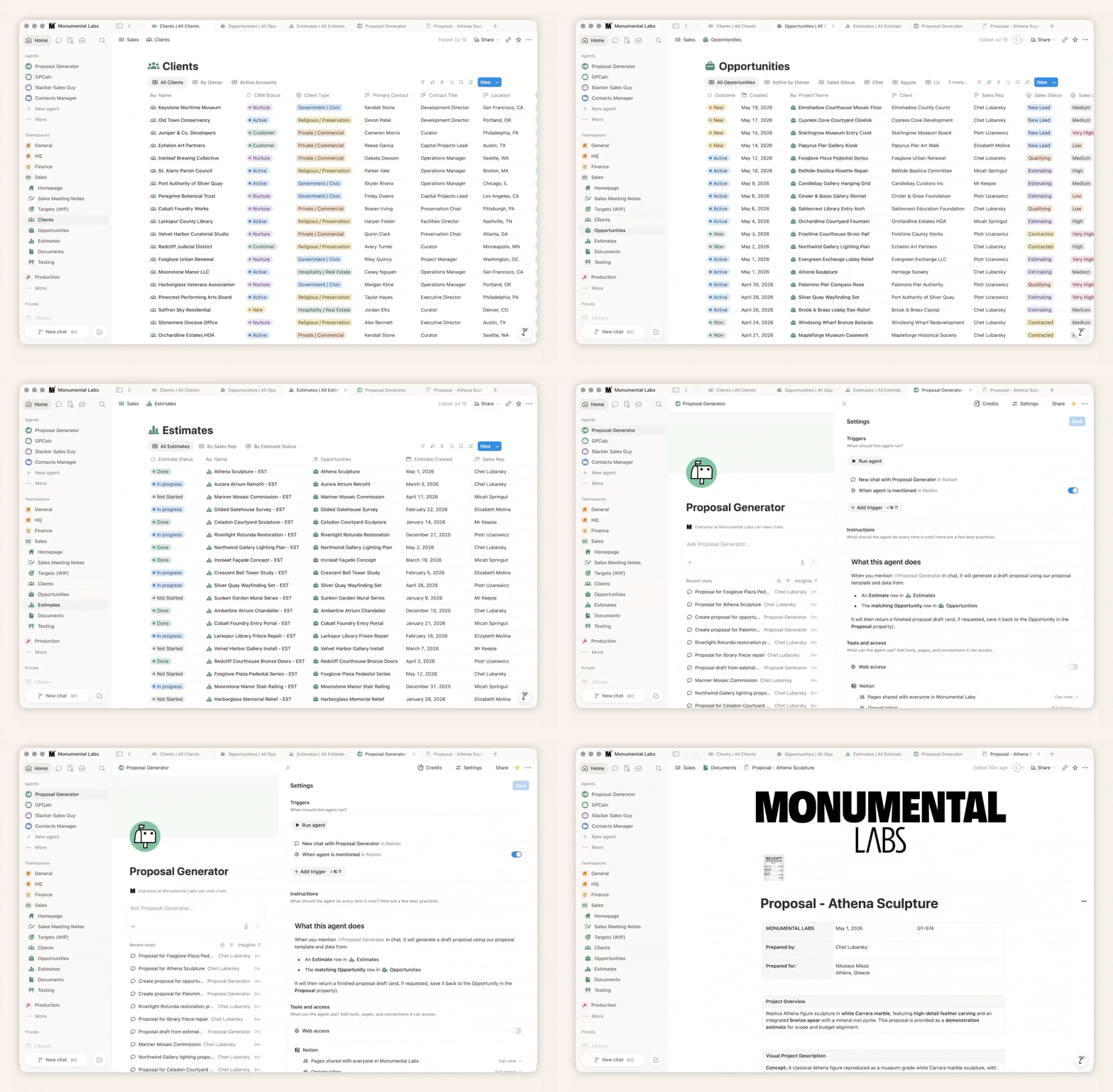
When Micah hired Chet Lubarsky, Monumental’s lead estimator, he centralized their knowledge in Notion around the records that matter most: clients, opportunities, estimates, and proposals. Now, Micah says, “From the moment a client comes in to the day the piece goes out the door, everything is tracked in Notion. It’s our source of truth.”
Leveling up: a Custom Agent that generates proposals
Centralizing information was only the beginning—once everything lives in Notion, the team could build automations that dramatically change where they spend time. Chet built an agent to accelerate client proposal work from hours to minutes. “Previously, somebody had to type up a proposal with all of the information about a new project. That clerical work takes a long time,” Chet says.
The agent reads the estimate, pulls in the opportunity, meeting notes, and other context, then uses a formatted template to produce a first-draft proposal page that’s ready for review. In other words, it turns structured internal context into a client-ready artifact. For Chet, the payoff is immediate: “Now the information just flows down the pipeline, and we can get things turned around for a new client really quickly.”
Client proposals are just one example. The agent’s success is already leading him to apply the same pattern—from structured context to agent creation to refined output—to other workflows.
Human stay in the loop to refine
The proposal generator doesn’t replace the salesperson or the estimator. Just as an artist finishes what the robot roughs out, the salesperson finishes what the agent drafts. But it removes the repetitive “reformat and rewrite” work that used to slow them down.
After the agent generates a draft, the salesperson reads through it, makes adjustments, and can even iterate with the agent—from something as simple as asking it “round the prices to fives and zeros” to more complex reformulations.
The draft also automatically pulls in the standard terms and structure the team needs: timeline, payment terms, change-order language, exclusions, transportation notes, and yes, a signing section. Export the page as a PDF and a team member can move on to the next deal.
Our Notion Custom Agents do exactly what we want. Everything is flexible and agile, they adapt to whatever you tell them, with humans always in the loop.

Why adoption worked: AI that meets people where they are
One reason the workflow spread internally is that it doesn’t require everyone to become an AI expert.
Chet describes the “aha” moment as simply being able to use natural language: “When we were able to use natural language to solve problems and tell it what we wanted to see, even people who had differing literacies with artificial intelligence got excited.”
Instead of creating a separate toolchain to learn, the team asks for what they need inside the workspace where the work already lives. And as the human-reviewed pricing data piles up in the Notion workspace, the team’s Custom Agent gets more precise about the hard parts, like estimating material costs and labor hours and surfacing relevant precedents. The agent is continually ratcheting up the sales team’s efficiency.
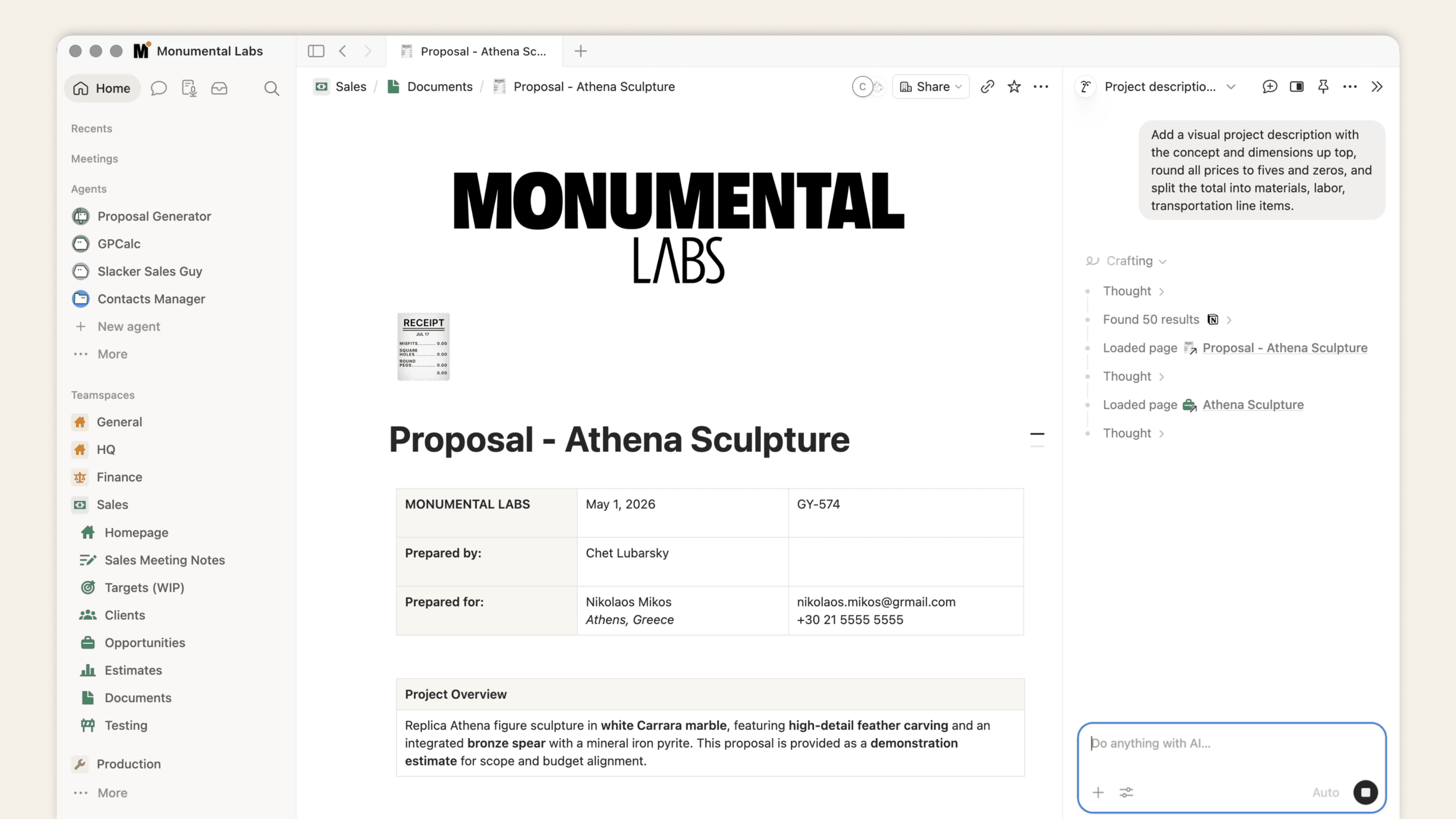
You can just verbalize what you want to see and the agent can create exactly what we want just by giving it plain language instructions.
Automate the busy work, protect the craft
For a 26-person company preparing to 5–10× production, the sales bottleneck could have capped growth. Instead, it became a machine always humming in the background.
Monumental’s view of the future of work isn’t abstract—it’s operational. “The more we reduce all that busy work in the digital world of bits and focus on atoms, the more we can do to create a beautiful world,” Micah says. “That’s our goal. We’ll let Notion take care of the rest.”