Remote konnte mit koordinierten Custom Agents von Notion ein erstklassiges IT-Helpdesk aufbauen
Remote nutzt Notion bereits, um Wissensdatenbanken, Projekte und Teams zu verwalten. Neuerdings werden auch IT-Anfragen automatisch mit mehreren Agents bearbeitet, die ihre menschlichen Kolleg/-innen nur in kritischen Fällen hinzuziehen. So kann das IT-Team den Support skalieren und dabei die Kosten um 7 % reduzieren.
A higher bar for IT: end-user experience
Remote is a fast-growing global payroll company with a team that’s fully global itself—so the company treats speed, clarity, and self-serve access to information as nonnegotiable. But as it scaled across dozens of countries, the cost of “waiting for answers” scaled with it. The knowledge existed, but finding it (or getting the right person to respond) slowed teams down.
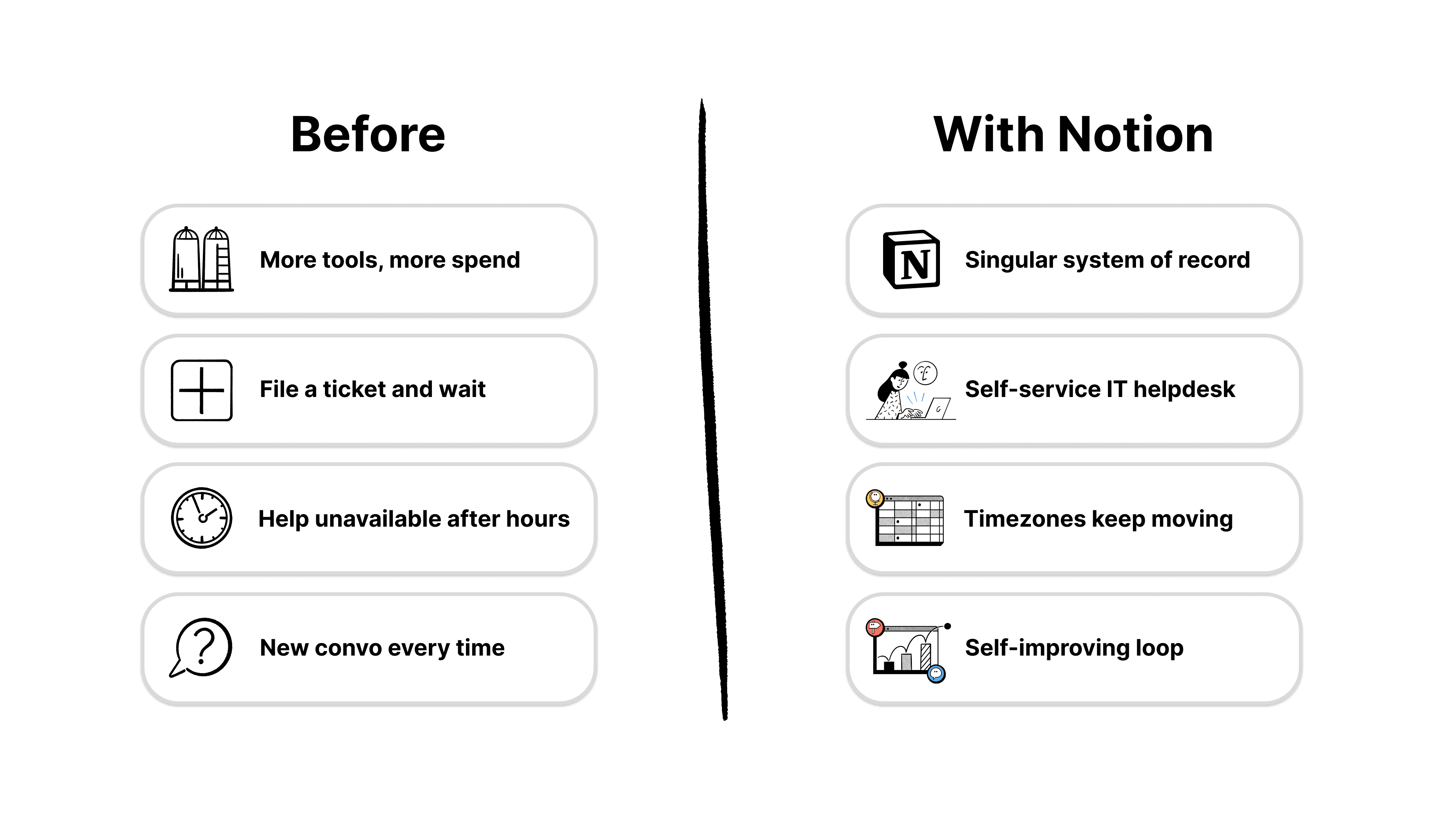
Since day one, Remote chose Notion as the home for all company knowledge. The team consolidated tools, kept context fresh, and saved over half a million dollars per year. But a single source of truth was only the starting point.
Today, Remote treats Notion as more than a wiki. It’s where critical business processes actually run, starting with an agent-enabled IT help desk that makes support feel fast, consistent, and human, even at scale. Now, roughly 1 in 4 resolved IT tickets are handled end-to-end by AI.
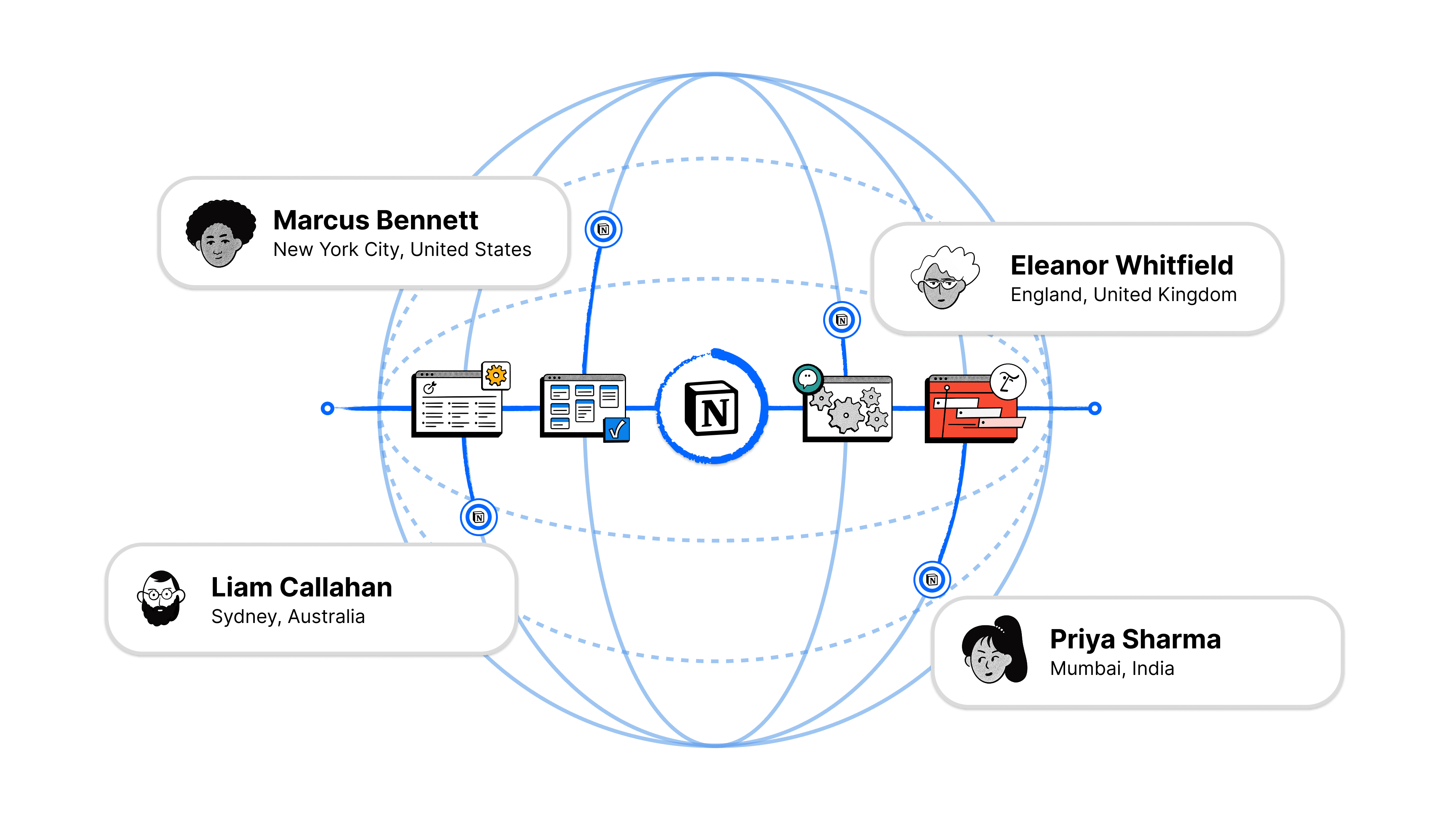
We’re fully remote and async. Notion started as knowledge management, but it’s become our HQ.

Ein Helpdesk, der auf Slack läuft und in Notion gehostet wird
Nach der erfolgreichen Optimierung der Suche kümmerte sich James um den nächsten Engpass. IT-Anfragen gehen oft über einfache Fragen hinaus, sondern erfordern Maßnahmen, eine Priorisierung und eine Nachverfolgung. Remote benötigte ein System, das den gesamten Lebenszyklus von Support-Anfragen abdecken und gleichzeitig die Mitarbeitenden in den Arbeitsfluss einbeziehen konnte.
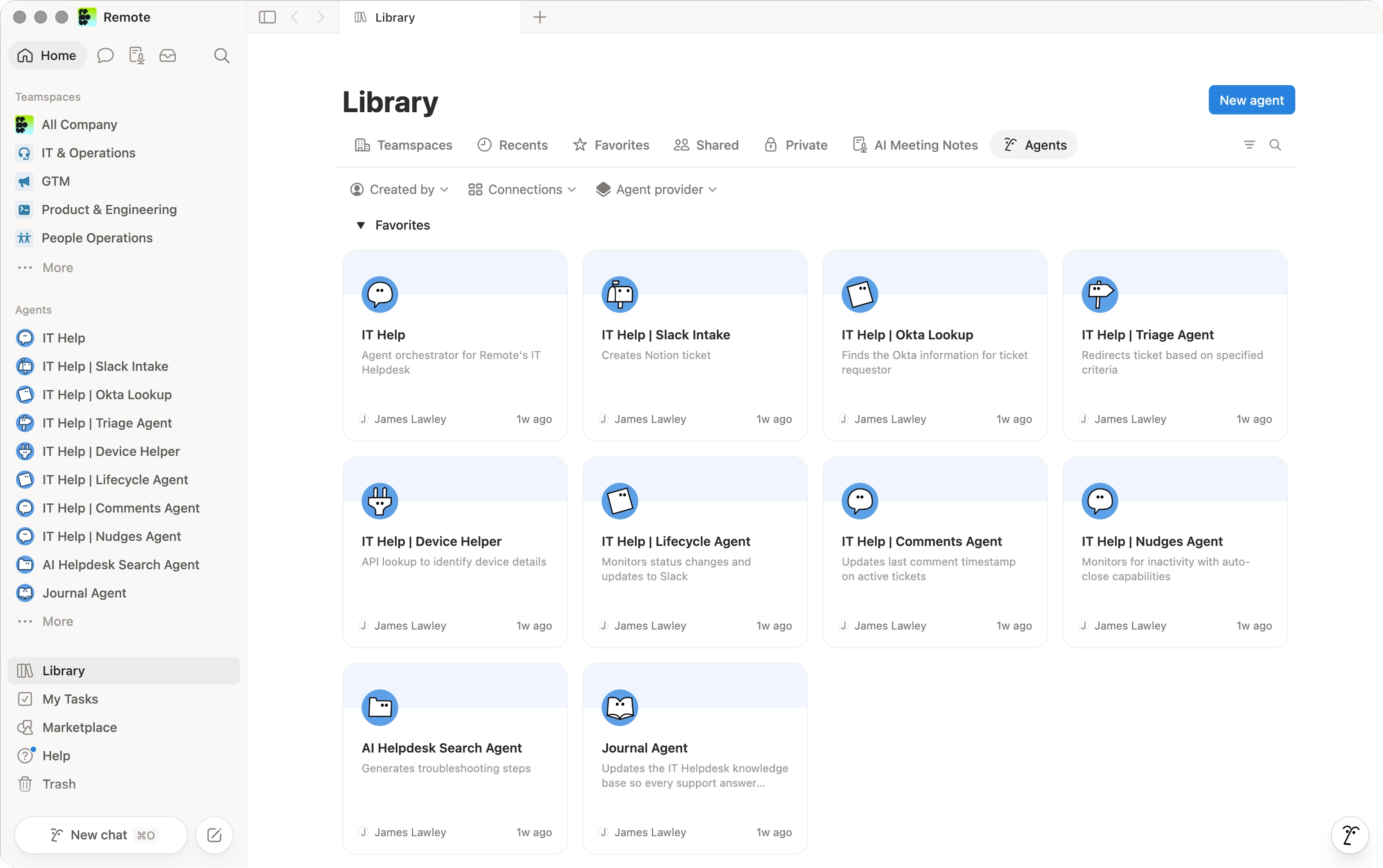
James‘ Lösung ist ein koordiniertes System aus Custom Agentsphrase-md-link-separatorhttps://www.notion.com/product/agents, das eine komplexere, lineare und vollständig von Menschen verwaltete Struktur ersetzt. Er wollte ausdrücklich keinen „Superagent“ entwickeln, sondern ein Team aus spezialisierten Agents mit klar definierten Rollen und strengen Kontrollmechanismen – denn ein einzelner Agent, der alle Aufgaben zu erledigen versucht, wird schnell zu komplex und unberechenbar.
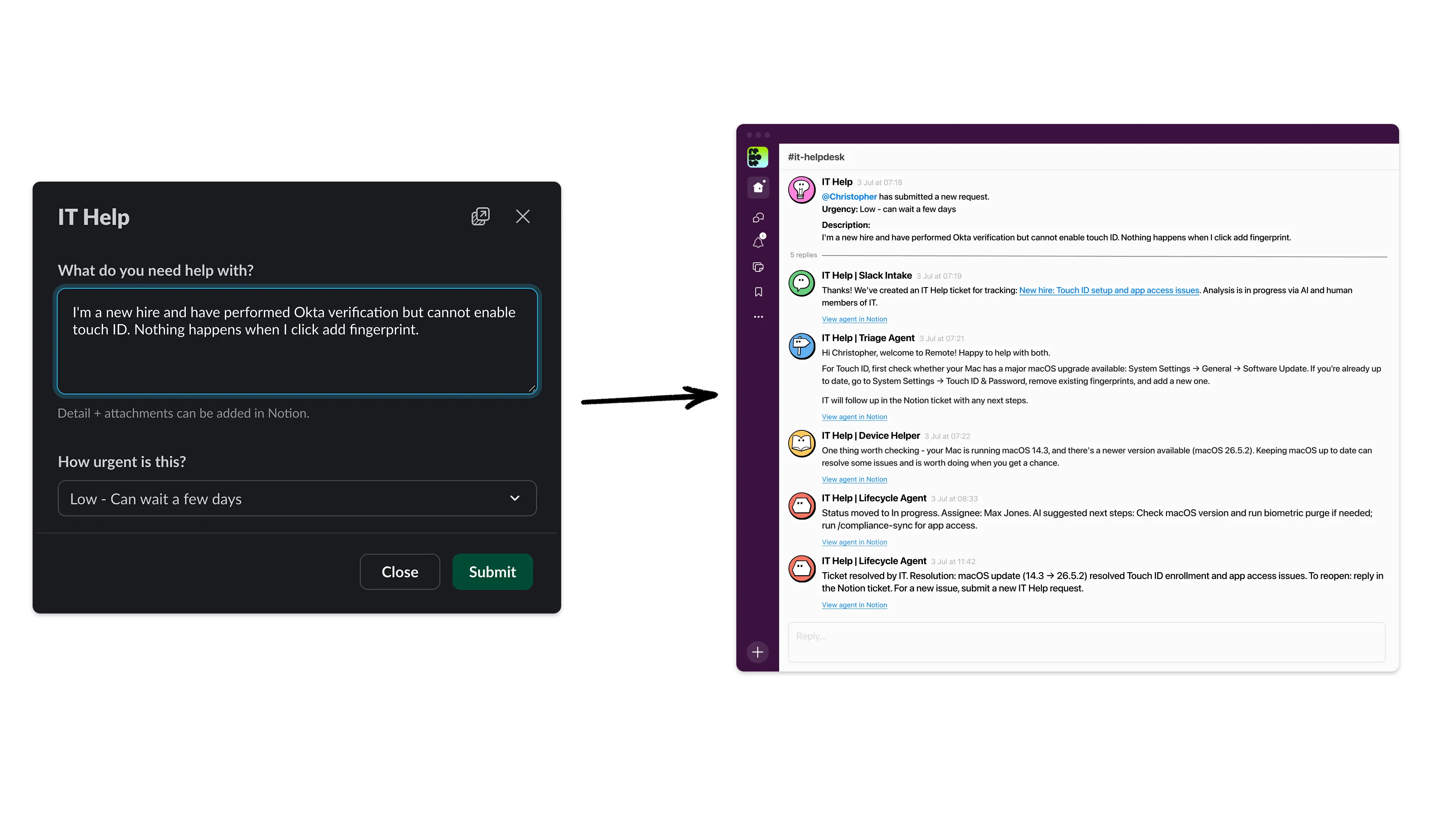
Im aktuellen Arbeitsablauf beginnt der Vorgang in Slack, wo die Mitarbeitenden von Remote ohnehin ständig eingeloggt sind. Anfragen gehen über eine unkomplizierte Interaktion wie eine Emoji-Reaktion ein, wobei von vornherein der Kontext in Alltagssprache mitsamt den richtigen Metadaten erfasst wird. Die weitere Bearbeitung übernimmt das System aus Agents.
Agent roles: Like an IT team, but automated
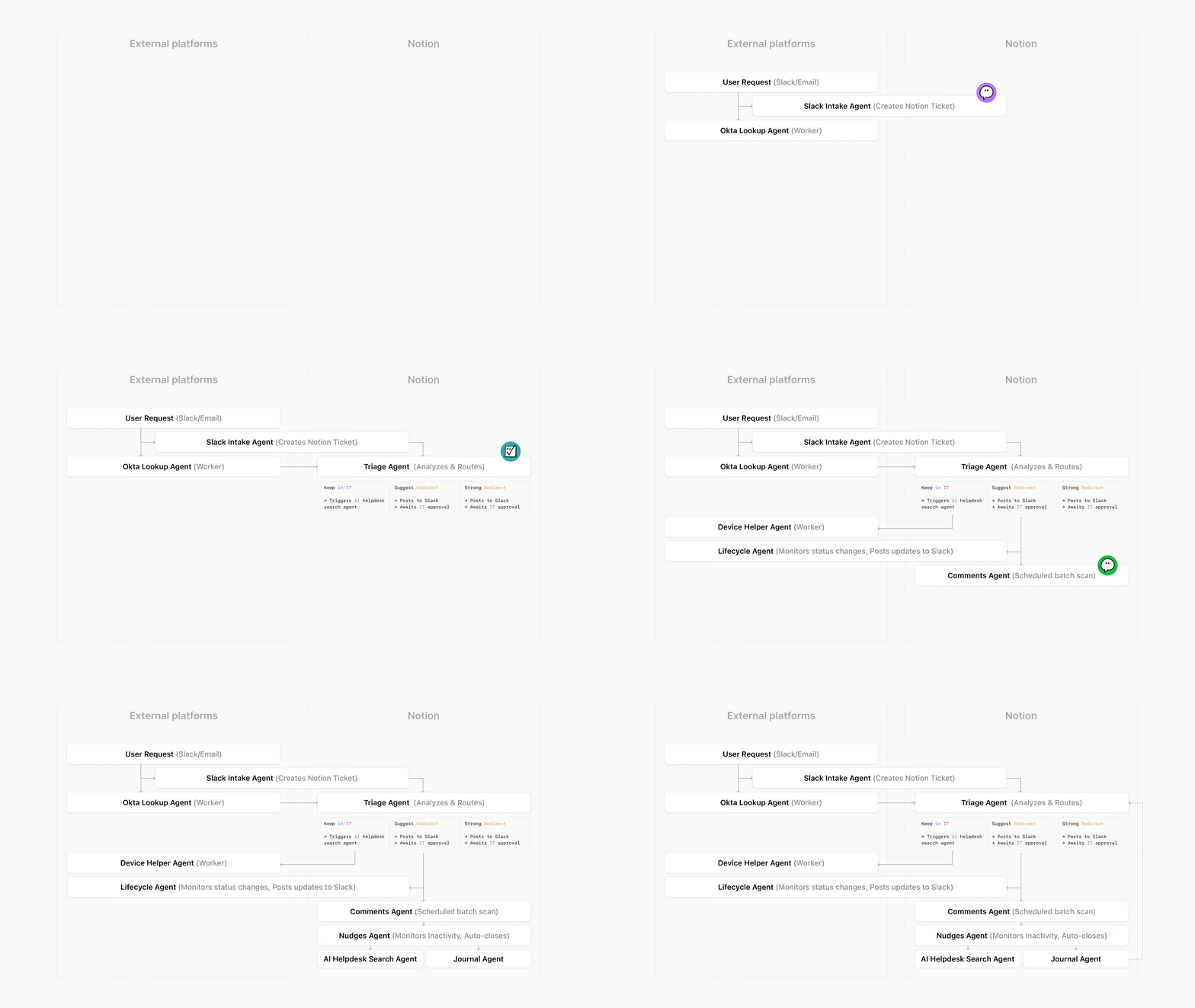
What happens next looks less like a bot answering questions and more like an IT team running a playbook—only the roles are automated.
Intake and creating tickets. This Slack-triggered intake agent captures the issue in plain text and creates a ticket in Notion, enriched with structured fields like priority, team/department, and a link back to the original thread. When necessary, the agent can also pull core user context via a read-only Worker integration for Okta to improve routing and reporting.
Triage. Another agent acts like the front line: it checks whether the request belongs with IT or should be redirected to another team, then searches across the knowledge base, historic tickets, Slack context, and the web (when needed) to propose a diagnosis and next steps. In Remote’s setup, this process includes explicit confidence: the agent rates how sure it is, and can auto-approve certain decisions above a threshold—keeping humans in the loop where it matters most.
Device-specific help. When triage suspects a device problem, a specialized device-helper agent can pull details like the model, OS version, and last reboot time from Kandji, then return targeted guidance to the same Slack thread.
Follow-up and closure. Support isn’t just diagnosis, so a nudges agent runs daily, checking for tickets with no activity in 72 hours, prompting the requester, and auto-closing after repeated nudges—saving hours of manual “just checking in” work each week.
From “we never taught it that” to a self-improving system
“We never taught it that—it’s not in the knowledge base.” James hears versions of that reaction often. Remote’s IT knowledge base remains the source of truth in Notion, but its agents now keep a private working journal alongside it—capturing new patterns, using repeated outcomes to improve triage, and moving the most useful fixes back into the main knowledge base. It’s the kind of self-improvement loop that James says “sparks joy when the agent saves us time later by self-solving a ticket.”
Throughout these interactions, the agent system is intentionally “human” in tone. James found that overly prescriptive instructions weren’t the answer; giving agents the freedom to “vibe” produced clearer, more helpful responses—and sometimes delightful ones, as when an agent congratulated someone on a promotion while still solving their problem.
The agents don't replace us, they scale our standards. We set the bar and they help us hold it for everyone, every time.
“Humans + agents”: not replacement, but standards at scale
At Remote, humans set the bar for AI, defining escalation paths, maintaining the knowledge base, refining instructions, and designing the guardrails that make automation trustworthy. What’s left over is execution: routing, retrieval, first-pass resolution, and consistent follow-through.
While 1 in 4 IT requests are fully resolved by agents from end-to-end, the rest are still supported by AI—for example, through ticket triage. This means the team can step in once the admin work is done and quickly carry the request over the finish line.
That human ownership shows up in how the system is built and maintained. James used AI to help write and refine instructions, but tested carefully—iterating in controlled environments with real ticket text and tuning for the right balance of structure and flexibility. The result is a support experience that’s faster for employees and more sustainable for IT.
Measuring impact—and what’s next
Remote has seen a growing share of tickets resolved with significant agent involvement—whether that’s full resolutions or workflows that still require explicit human input. And because the system runs in Notion, Remote can keep improving it: updating instructions, refining routing, and enriching tickets with additional context.
Over the first few months, AI resolutions grew ~35% while overall ticket volume stayed flat, meaning AI is genuinely taking more work off the team's plate. Plus, the AI is getting more efficient by iterating on its own instructions, consuming 35% fewer credits and 7% less spend compared to its initial launch month.
Looking ahead, Remote is already experimenting with Workers that pull read-only context from other systems like Okta. The long-term direction is clear: carefully expand what automated systems can do while keeping humans in control of the outcomes and the standards.
Remote already ran its knowledge, processes, and team in Notion—so as IT requests scaled, they built an agent-powered help desk right where employees work. It keeps every request tied to the right context and moves tickets from intake to triage to follow‑up, bringing humans in only when needed.
When you have this huge amount of knowledge and context living in Notion, and it integrates with Slack too, it's basically priceless.