
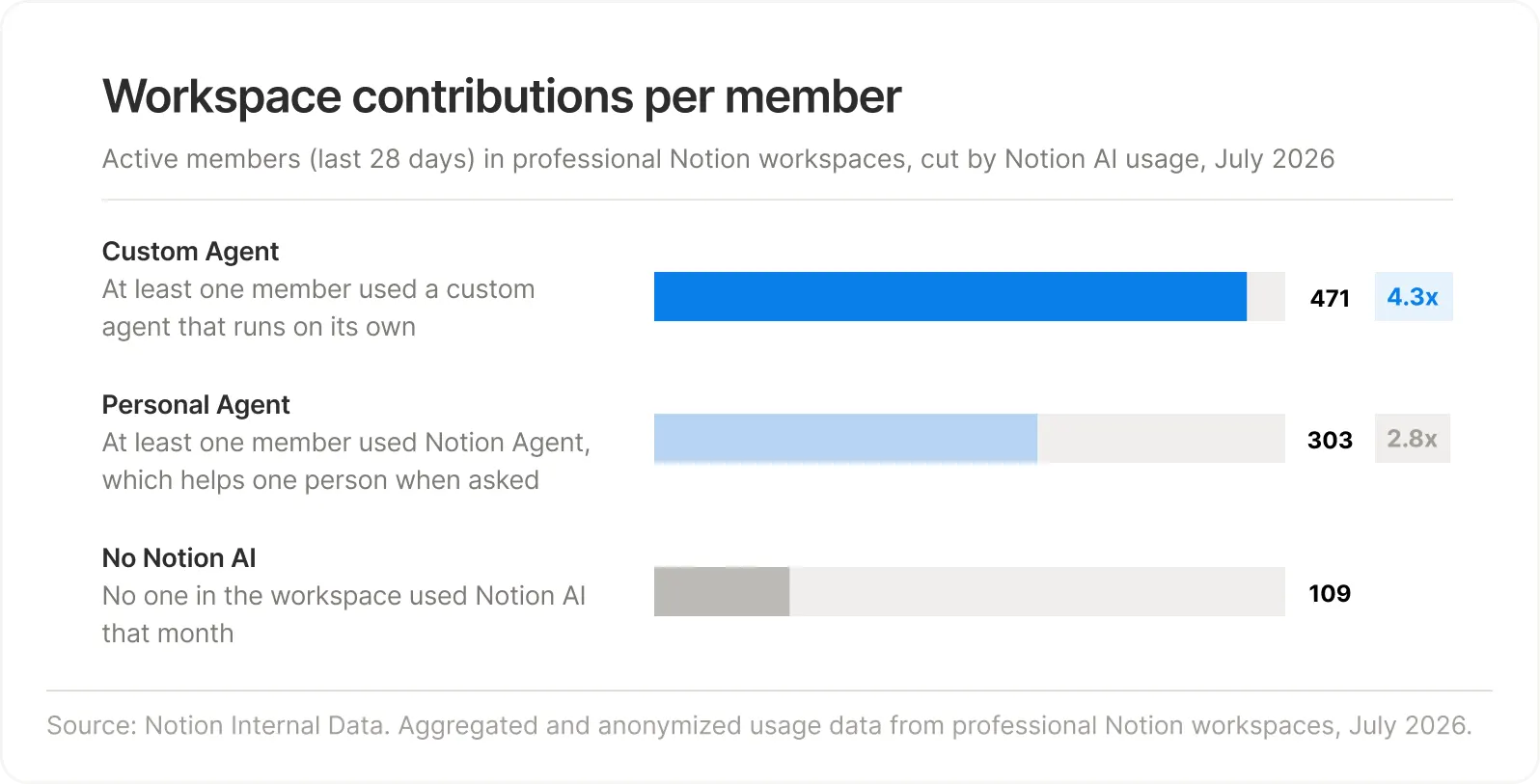
Across thousands of professional Notion workspaces, teams using Notion’s most advanced AI features make up to 4.3× as many workspace contributions per person as teams that don’t use Notion AI at all.
Our research focused on a year of Notion usage data, surfacing how teams that use AI contribute and collaborate more often, find information from coworkers outside their immediate team, and create shared workflows that reach more people.
These patterns within Notion workspaces point to the foundations of a context system. When people and agents contribute to shared knowledge, they start a flywheel. Each contribution makes the next one more useful, gives others more to discover, build, and reuse, and extends the value of information beyond the teams that created it.

About the data: Our analysis draws on aggregated and anonymized Notion usage data, supplemented by enriched information on job seniority and departments. To protect customer privacy, findings are presented at an aggregate level, without identifying individual users or organizations. Our goal is to highlight broader adoption trends, share actionable insights, and help teams learn from emerging best practices in how people collaborate on Notion.
Teams that use Notion’s most advanced AI features see up to 4.3× as many contributions per person as teams that do not use Notion AI (471 vs. 109 per person). These contributions range across the Notion workspace, including editing documents (56% of Notion users who don’t use Notion AI vs. 81% of Custom Agent users), commenting in threads (15% vs. 38%), and editing databases (39% vs. 64%). These behaviors in Notion are the foundations of how teams build context together.
The team spends half its time in Notion before building anything. It’s the shared brain for the company, and our coding agents read from it before they ship.
Founder at a 15-person AI startup
The relationship between Notion AI depth and context speaks to a broader pattern: AI is pulling more of the team into shared, collaborative environments. Every contribution adds a piece to the puzzle that the whole team (and also AI) can reference the next time.
So what: When only a few power users adopt it, AI remains a personal productivity tool. The real sign of AI transformation is when more teams show up for the work—editing, commenting, and building on what others started.
AI surfaces knowledge beyond immediate teams
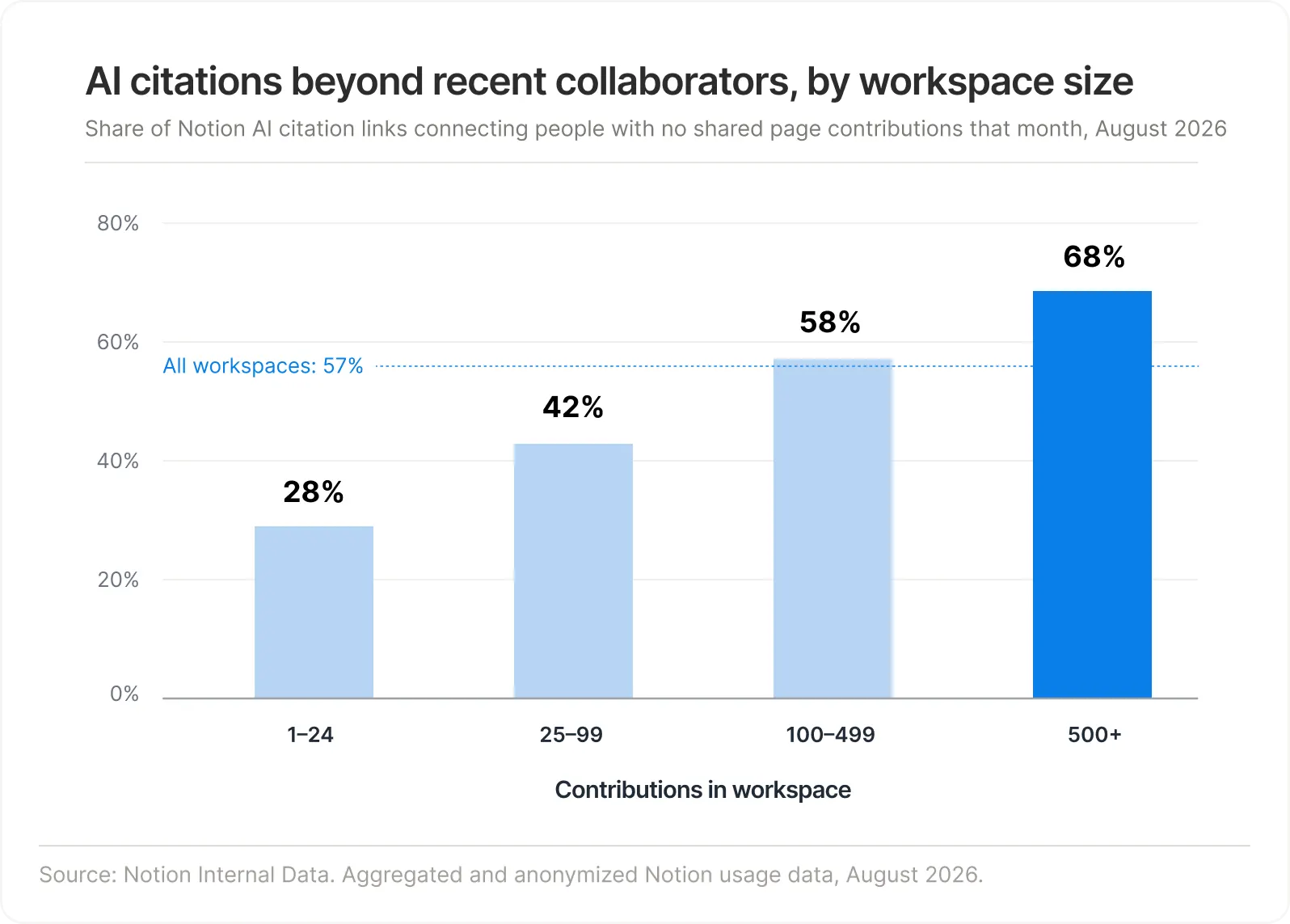
57% of Notion AI citations pointed to pages by coworkers the user hadn’t collaborated with that month. More than half the time, Notion AI referenced work beyond users’ recent collaborators. That reach compounds with the size of the company. In Notion workspaces with 500+ members, 68% of citations come from outside of users’ typical teams.
I’ll ask, ‘Has anyone in Notion already created a proposal or had a discussion about this problem?’ It’ll tell me if someone’s already started on it, and who I should go talk to.
Forward-deployed engineer at a 1,600-person fintech
There is a hidden cost within large, growing companies. Often, there are questions that keep getting asked, or institutional knowledge disappears when people leave. Every doc, decision, and update needs to be captured and indexed for future work to build upon.
So what: In smaller organizations, you know every person, so you can typically find an answer quickly. But in larger organizations, teams depend more on AI to connect people to work they’d never have found on their own or answers they didn’t know existed.
The depth of workflows shape how far they spread
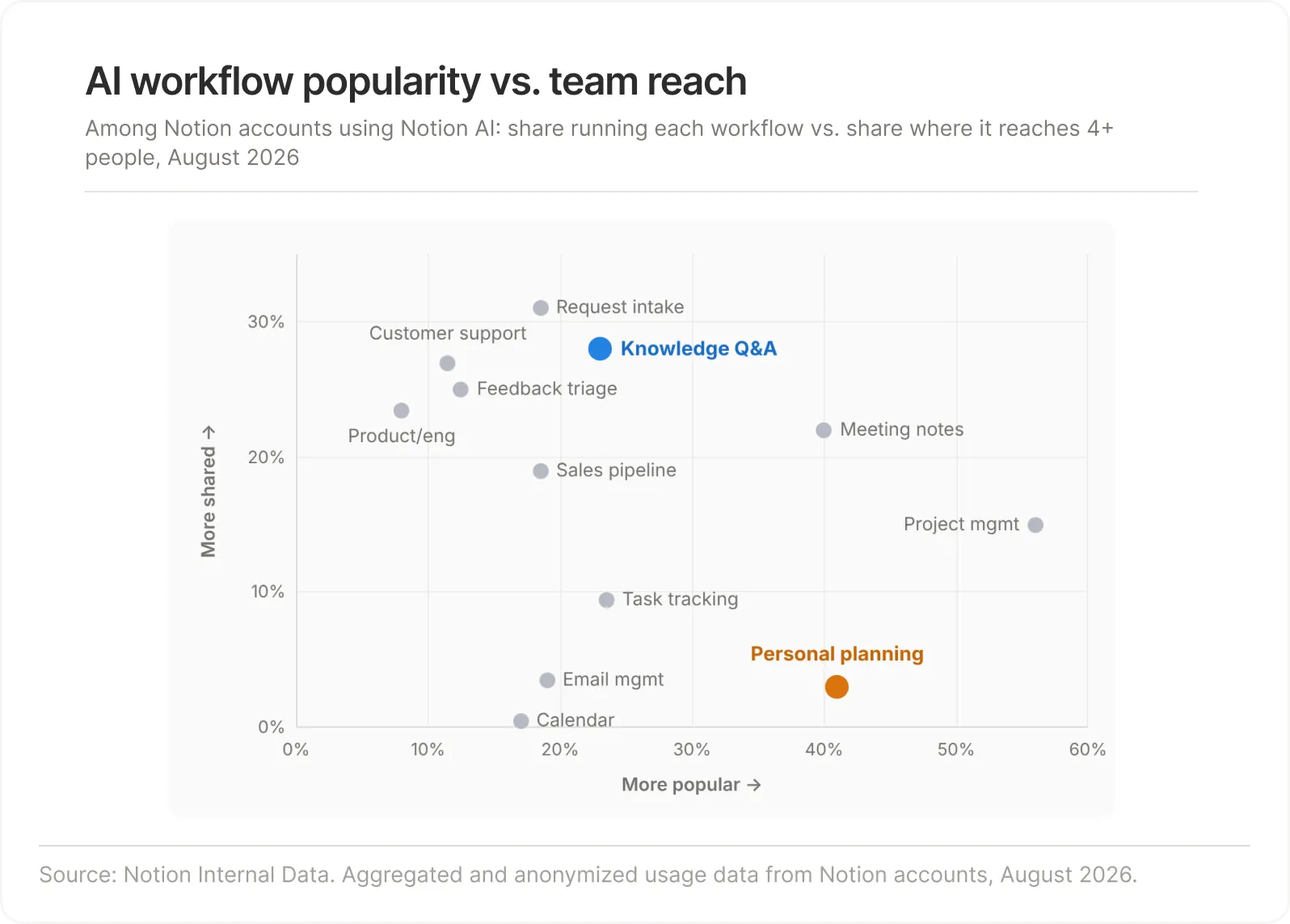
AI workflows built in Notion that are intended for shared work reach the most people. Examples like knowledge Q&A, request intake, customer support, and feedback triage typically reach four or more people. Generally, though, only a small number of users are building these workflows.
In contrast, personal planning workflows like email and calendar management are rarely shared but are built far more often. When a workflow is built for a team, there are more opportunities for people and agents to benefit from and refine it.
I built an intake agent in Slack. The customer didn’t give enough info, so the agent asked for more. It tagged someone else who had the answer. By the end, my ticket had everything, and I didn’t have to be involved. Took me an hour to build.
Analytics director at a 50-person gaming studio
This shows us that the reach of a workflow in Notion follows the shape of the need behind it. Just because people are building with AI doesn’t mean it’s the best application for your team. Work that travels farthest are activities and processes that multiple people share. That is the kind of work that compounds knowledge within a workspace, because the next person doesn’t start from scratch.
So what: Workflows that are worth tackling first are the ones a whole team depend on. They’re typically built by a small group of builders that control the “how” and the “who” of the rollout.
The flywheel behind it all
More contributions, bigger teams, org-wide workflows—they all build upon the same thing: a growing system of shared context.
Through this exercise, we saw that the value of AI increases with how much shared context it has to work from. On smaller teams, AI helps you find what you already know. On larger ones, it becomes how you find what you don’t. With agents, that’s the difference between the right result and the wrong one.
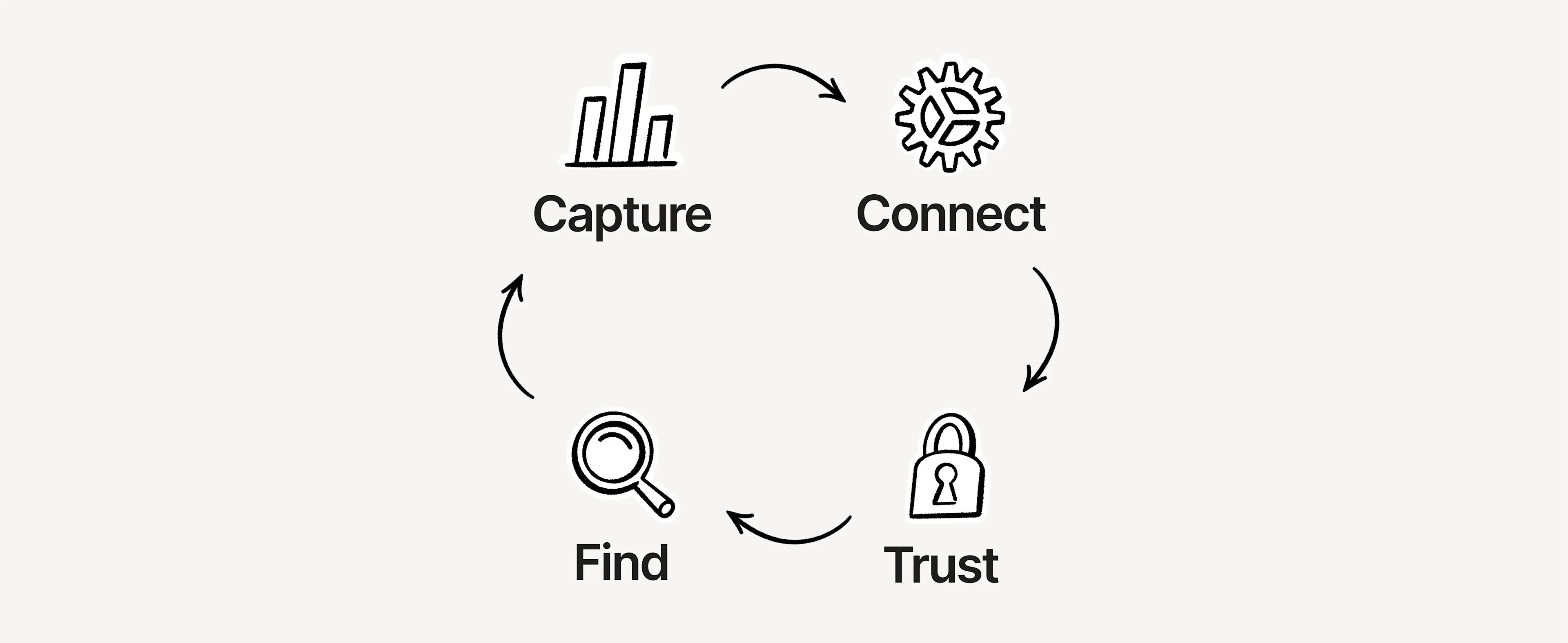
Every contribution to shared context makes the next action even more valuable. That’s the flywheel. Teams and companies that treat AI as a shared context system, not a personal productivity tool, are the ones getting the most out of it today. They’re also the ones building the foundation to succeed in the future.
How to bring this into your work
Start with the workflow. Workflows that spread across workspaces are the ones built around a shared need more than a personal need. Personal tools stay personal, no matter how many people create them.
Ask yourself which recurring need serves more than one person. That’s the workflow worth building first with AI.
Then build the system. Every time teams leaves Notion to find something, that’s a context gap. Each new connection closes that gap, and gives people and agents more of the shared context they already rely on.
Ask yourself what the team keeps leaving Notion to go find. That’s the next integration worth adding.