
How Heidi scales globally and saves 260+ hours a month with Notion AI
When Heidi, Australia's fastest-growing health tech company, expanded into 150+ countries in a single year, critical decisions started disappearing into Slack threads and time zone gaps. The fix was not another tool. It was a cultural shift toward writing, powered by Notion AI.
The cost of context trapped in people's heads
Heidi gives clinicians an AI care partner that helps them double their capacity. The product works across 110 languages, from English to Japanese and Swahili, and in 2024 alone the company scaled from its home base in Australia to more than 150 countries.
Growth that fast creates a specific kind of friction. Knowledge about decisions, processes, and customer needs lived in the heads of the people who made them. When a teammate in a different time zone needed that context, they had two options: ask and wait, or guess and move. One cost time. The other introduced risk.
The same questions surfaced again and again. Onboarding a new hire meant weeks of shadowing before they could contribute independently. Strategic decisions made on a call disappeared into calendars the moment the meeting ended. The communication overhead was not linear. It compounded with every new person, every new market, every new product surface.
Heidi needed a system where knowledge was durable, searchable, and owned by everyone.
The first place you go is the canonical source of truth. If you cannot find your answer there, you go to the person with tribal knowledge. When they answer it, we add that to the source.

A single source of truth, searchable and supported by a culture of documentation
The solution started with the CEO. Dr. Thomas Kelly writes what the team calls "yearly canons": strategic documents that lay out Heidi's direction and are accessible to every employee. For Thomas, writing is not documentation. It is thinking. He values its permanence because it gives you time to edit, rethink, and clarify your intent into a clean, true description of what matters.
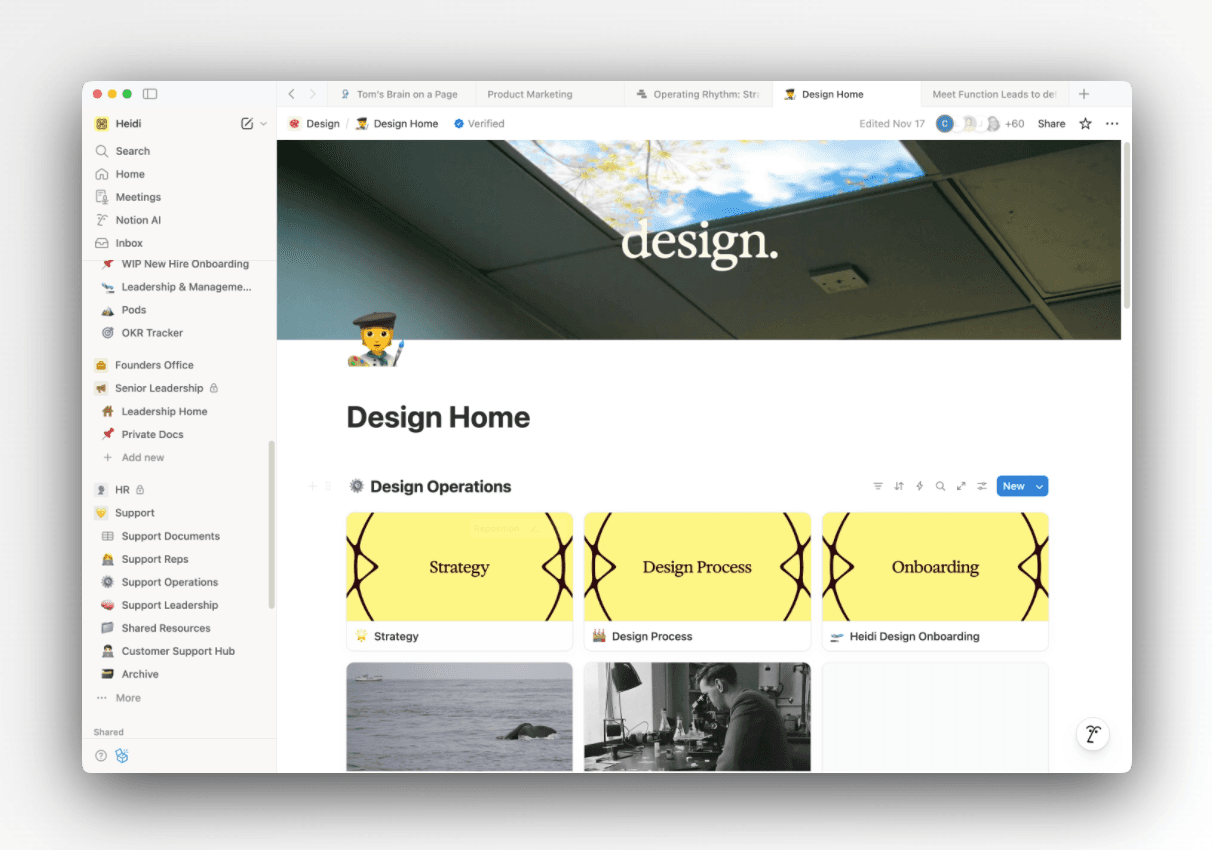
That top-down commitment set the tone, but it was the day-to-day system that made it stick. Heidi built what they call their "bulletproof workspace" in Notion: connected databases rather than scattered docs, with everything searchable from a single entry point.
That feedback loop is the key detail. The system does not just store what people already know. It captures what people ask, fills the gap, and gets smarter over time.
Notion AI Meeting Notes extended this culture into conversations. Decisions, action items, and the reasoning behind them are captured automatically and made searchable for the whole company. For Thomas, key calls no longer vanished into calendars. For Christie Katris, Heidi's Chief of Staff, it meant staying close to the work across every team without having to shadow every meeting.
As adoption grew, ownership shifted. Team leaders began designing and evolving their own hubs, building pages and workflows the central team had not anticipated, and doing it without the fear of breaking anything.
Custom Agents turning repetitive work into automated workflows
Faster knowledge retrieval solved half the problem. The other half was the operational busywork that pulled people away from high-value decisions.
Before Custom Agents, Heidi's product team fielded a steady stream of internal questions: What is the status of this feature? What are the top support themes this week? When is this shipping? The answers existed, but assembling them required a human to context-switch, dig through multiple tools, and type a summary. Multiply that across a growing company, and you have a significant drag on the people who should be building product.
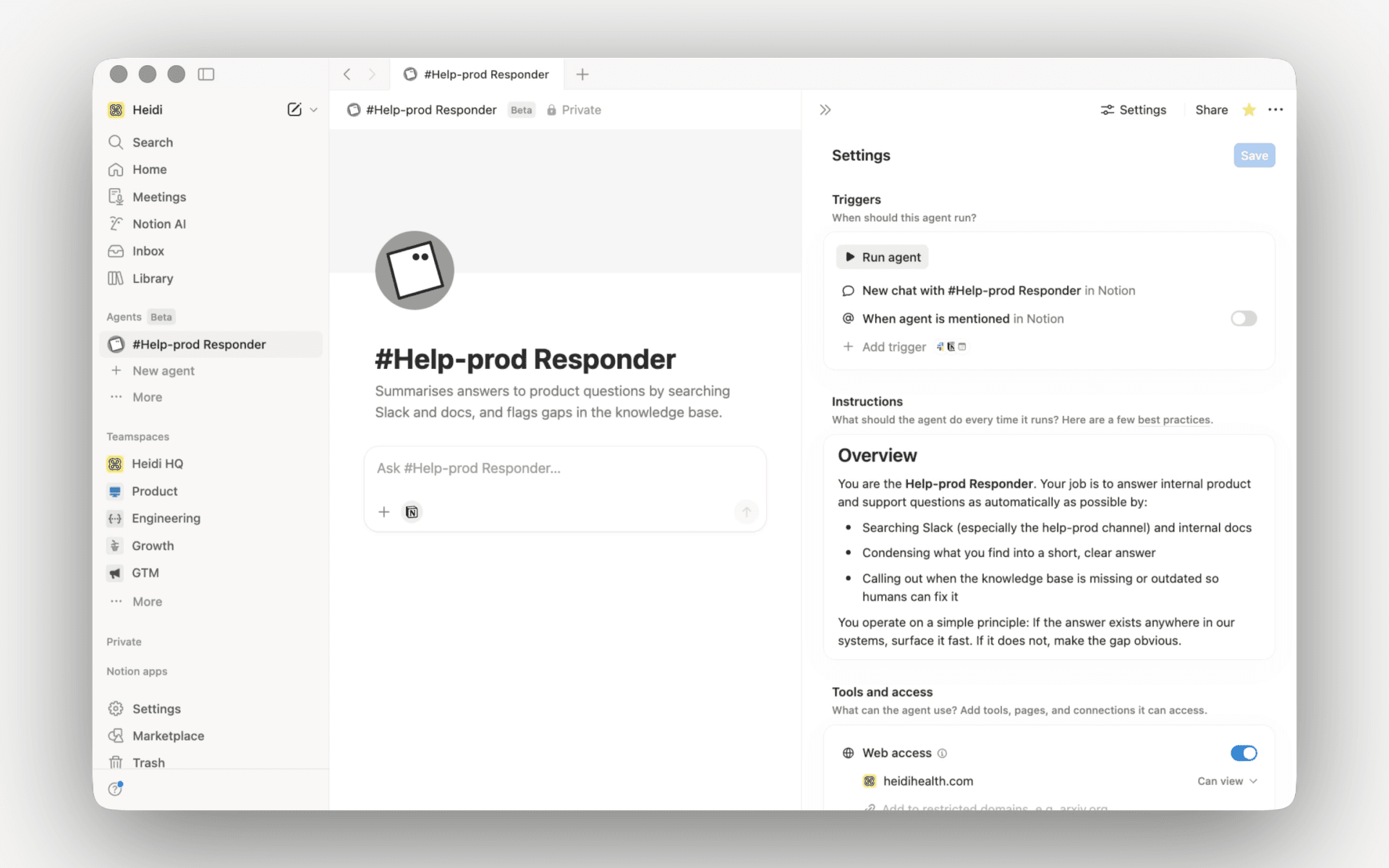
Heidi built a Custom Agent to handle support ticket triage. It connects to their issue management software, Slack, and Gmail, and gives the broader company a fast path to answers on product plans, support themes, and what is changing. The agent pulls the relevant data, condenses it into a clear response, and replies directly in Slack.
When the agent cannot confidently answer, the workflow escalates to the relevant project owner. Over time, those misses have become a signal to improve. Each unanswered question points to a specific knowledge gap the team can close, so the system gets sharper with use.
Heidi estimates Custom Agents are already saving 60+ hours a month, and the return keeps growing as more workflows are automated.
We’re getting back more than 60 hours a month today with Notion Agents handling a lot of the busywork. And we’re still early on in our adoption, but the more we invest in these custom agents, the bigger the return.

From documentation to prototypes in 24 hours with Notion MCP
The same documentation-first culture that powers Heidi's operations also accelerates how their product team builds.
Heidi’s Product team works in an unconventional way for non-engineers. They build in Claude Code, running in a Cursor terminal, using a simple file based system to generate prototypes, mock ideas, and capture customer interviews. Notion’s MCP integration makes the workflow practical. It connects their build environment to the tools and sources they already rely on, including Slack and Gmail.
With that context in place, the team can move from concept to customer-facing prototype within 24 hours. The documentation that Heidi invested in building is not just organizational memory. It is raw material for product development.
The change management that made adoption stick
None of this works if people do not actually use the system. Christie Katris knew that, so she treated the migration like an enablement program, not a rollout.
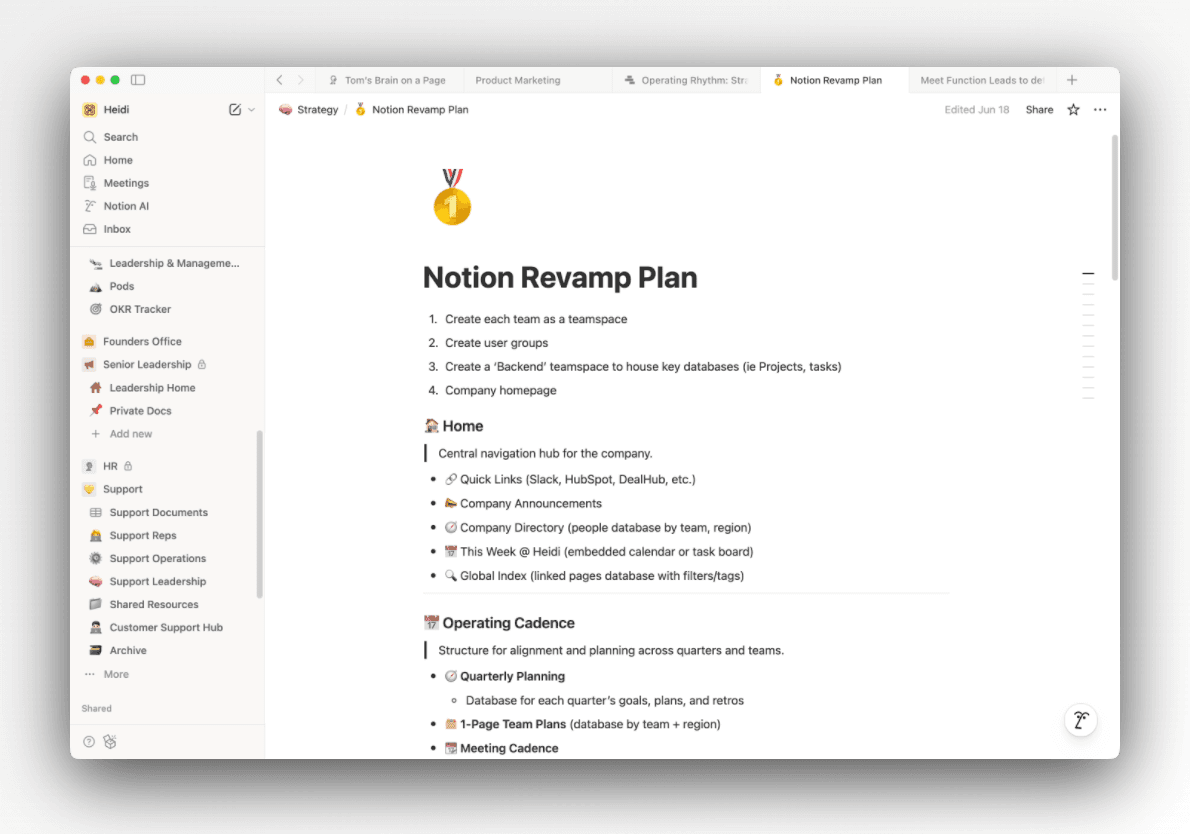
Christie and Mohamed Ismail, Head of Product, launched an internal workstream they called Project X to rally leadership around a simple idea: Heidi needed one centralised hub for company knowledge, accessible to every team. But instead of flipping the switch for everyone at once, Christie started small. She booked time with each team to understand how they were already working: what tools they used, what was effective, what was not. Then she built lightweight team homes in Notion that mirrored familiar workflows, just more flexible.
The key was reducing perceived risk. Christie identified internal champions in each team who could reinforce new habits and unblock questions day to day. Teams experienced incremental gains until the new way of working felt obvious, not imposed.
Heidi’s change management playbook
Seed the change with leadership, but start small: Frame the need for a single, centralised hub and begin with a lightweight pilot rather than a company-wide switch.
Create early wins in a contained space: Spin up a simple account and use it first with a small set of teams (e.g., sales, strategy, or ops) to prove value quickly.
Listen first, then mirror existing workflows: Book time with each team to understand how they use their current tools, what works, and what does not. Then build a lightweight team home that feels familiar, just more flexible.
Identify internal champions: Pinpoint a few champions inside each team who can reinforce new habits and unblock questions day to day.
Take "baby steps" to reduce resistance: Let teams experience incremental gains until the new way of working feels obvious, not imposed.
Shift ownership to team leads: Get each lead confident enough to own their team space without fear of "breaking" anything.
Bake Notion into onboarding: Make every new hire's first touchpoint Notion. House their onboarding there to create early exposure and consistency.
Use Notion to run change, not just document it: Draft new processes, circulate for input, approve, then capture as a single one-pager so the "new way" is explicit and retrievable.
Notion is saving us 200+ hours every month we used to waste hunting for answers. Now the context is there, searchable, and the work keeps moving.
A system that compounds as Heidi grows
Combined, Heidi estimates Notion saves the company more than 260 hours every month: 200 hours from faster knowledge retrieval and 60+ hours from Agent-driven workflows. But the real payoff is not just speed. It is decision quality.
As Heidi adds more people, managers have more context to make better decisions without pulling others into another meeting. Every new hire contributes to the knowledge base instead of draining it. The system gets more valuable the larger Heidi gets.
Heidi has treated this as a culture shift as much as a tooling shift. Many organisational problems come from underinvesting in writing and documentation. Investing deeply in that, and giving the writing an intelligent layer with Notion AI, is what made it possible to move faster without losing clarity.
As Heidi builds toward its mission of becoming an AI care partner for every clinician in the world, the foundation is in place: strategic thinking happens in writing, decisions get captured, knowledge is searchable, and the system improves with every question asked.