How Equals Money automates 24 hours of weekly busywork with Custom Agents
When UK fintech Equals Money started producing code three times faster, its manual processes couldn't keep up. With Custom Agents in Notion, the team now automates documentation updates, release approvals and customer feedback triage – saving 24 hours a week. The result: every team now has the tools to build workflows that benefit everyone.
Scaling without the busywork
At Equals Money, product features ship fast. Jake Clarke's job is to make sure everything else keeps up.
As the company's product marketing and operations lead, Jake keeps the internal knowledge base, public website, FAQs and product guides up to date across multiple product teams. But managing this manually was becoming increasingly time-consuming. With releases shipping every week, critical updates and customer feedback were getting lost in the noise of busy Slack channels. Jake's team simply didn't have the bandwidth to track down every change.
On the engineering side, VP of Technology Rich Coombes was watching the same dynamic play out on a different layer. AI coding tools had tripled output, but the surrounding processes – product requirement docs, architectural decision records and release approvals – hadn't kept up. "When your code production increases, your manual processes suddenly become the limiting factor," Rich explains. "Our product owners were ready to deploy changes, but the engineering teams couldn't get them out the door because of the administrative overhead."
To keep pace with a fast-growing business, Equals Money needed to eliminate busywork. By automating the work that doesn't require human judgement, people can focus on what actually matters: the premium, personalised service that Equals Money prides itself on.
Growing the business doesn't always mean growing the team. It means automating the busywork – so people can focus on what only they can do.

Documentation that keeps itself current
Equals Money ships multiple product releases a week, so when information gets stale, it's costly. The big launches get attention, but the smaller feature updates were easy to miss. "We were relying on humans to spot changes in busy Slack channels," shares Jake. But those missed updates meant customer-facing teams might not be sharing accurate details.
Jake needed a way to make sure every product change was reflected in internal and external documentation, so he built a connected system of three Custom Agents:
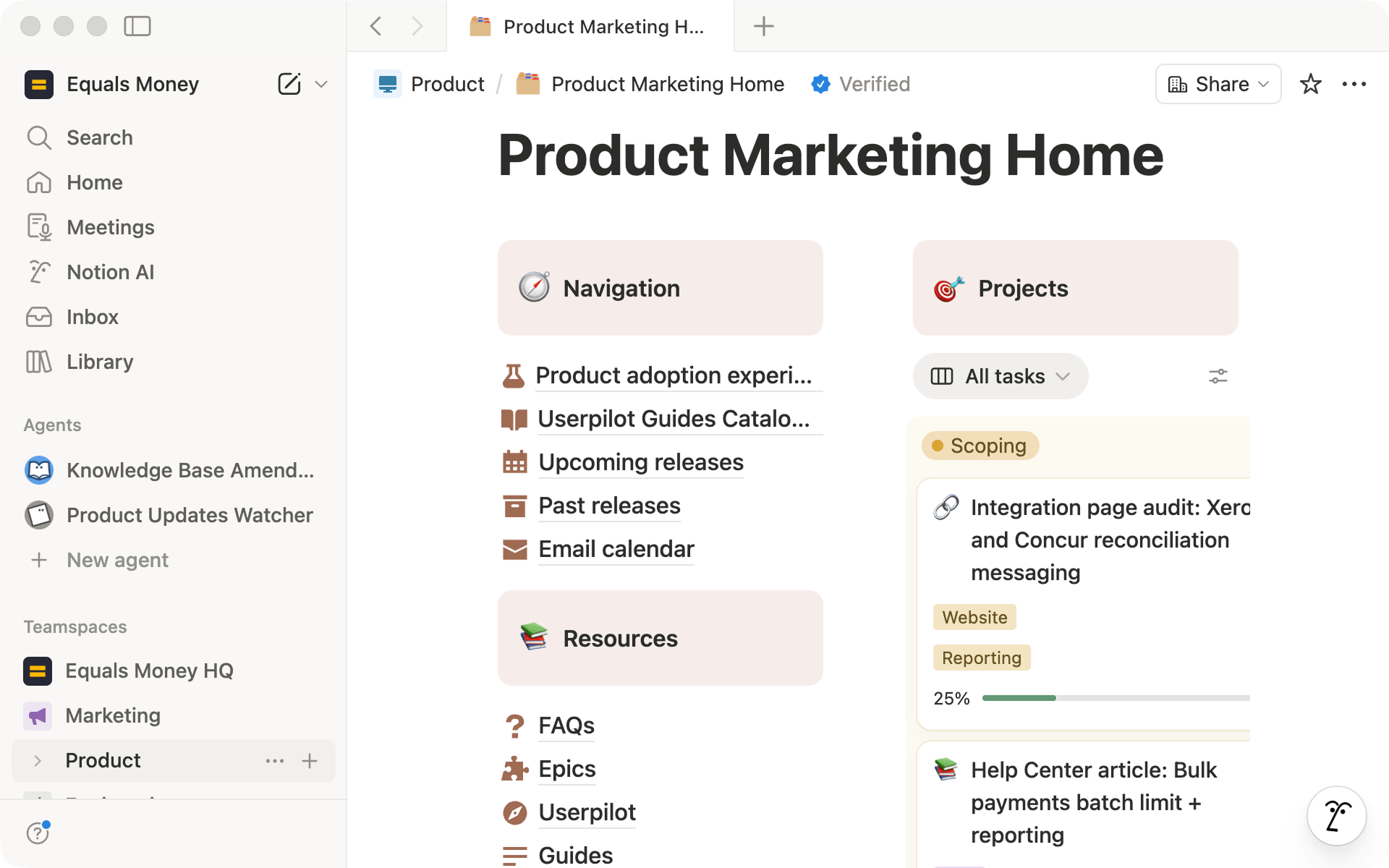
A Product Updates Watcher that monitors core product Slack channels, identifies qualifying releases and logs them into a central "Product releases" database in Notion.
A Product Education Helper which answers product questions directly in Slack using information in Notion and public guides. Staff get a sourced, detailed response in seconds, complete with links to relevant Notion pages and previous Slack announcements.
The Knowledge Base Amendment agent, which cross-references each release – and gaps surfaced through conversations with the Product Education Helper – against Equals Money's internal knowledge base, public FAQs and website. When it finds something outdated, it automatically updates content in Notion and creates a task with suggested website edits.
Now, every release is captured, every knowledge gap is flagged, and fixes happen while context is still fresh – automatically, within minutes of each announcement. In the first week alone, the Product Education Helper answered 160 questions. Questions that used to require a Slack thread, a wait for a product manager to surface the right doc and follow-up clarifications are now resolved instantly, around the clock.
Our product documentation used to require periodic clean-ups. With Custom Agents, it maintains itself.

Removing bottlenecks from engineering delivery
For Rich, the issue wasn't engineering capacity – it was everything wrapped around it. Every change needed a ticket, every ticket needed a review, and every review depended on a human being available with the right context. The faster the team shipped, the more these manual steps held them back.
Rich's answer is an end-to-end automated delivery pipeline, built in Notion:
The Create Ticket agent triggers from an emoji reaction in Slack, reads the message and checks for duplicates. If it's a new issue, it creates a ticket with drafted background, scope and acceptance criteria, then auto-routes it to the engineering backlog.
The Release Request Standard agent runs a standardised first-pass review on every technical change, checking for missing evidence, unclear customer impact and absent rollback plans. Since its inception, it has processed 453 reviews, saving an estimated 37+ hours of review time.
The team is already working on the final step: connecting the pipeline to Claude Code, automatically turning a triaged ticket and drafted fix into a pull request. The busywork disappears. The work that matters doesn't.
With Custom Agents, we're reimagining entire workflows from scratch rather than just optimising existing processes – inserting humans only where creativity, approvals and guardrails are needed.
One person builds. Everyone benefits.
Equals Money already saves over 24 hours a week across feedback triage, release documentation and engineering delivery – and the number keeps growing. Because so much of the company's work runs on Notion, anyone can create a productive Custom Agent in minutes – no additional context-building required. What one person builds, the whole team inherits.
That shift is accelerating as new Custom Agents keep popping up across the business:
An SEO/AEO Opportunity Finder compares each release against Equals Money's priority verticals, scans relevant web pages and produces a prioritised action list. Following a recent regulatory update, it generated five specific recommendations across product pages and FAQs – four hours of manual analysis, done automatically.
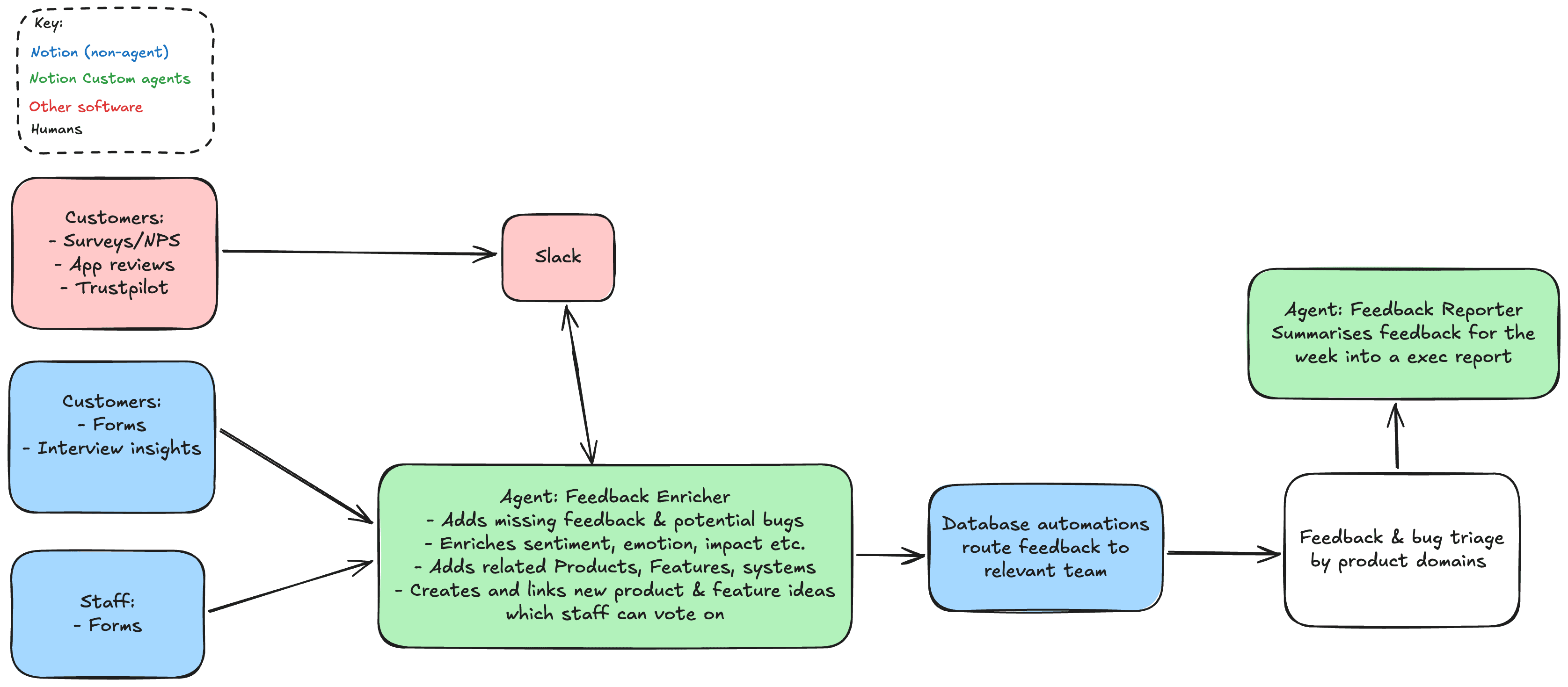
The Feedback Enricher automatically processes 50 to 75 pieces of customer feedback each week – scoring, tagging and routing each one to the right product team. The weekly report that once took three hours to compile now takes minutes.
"People are realising what's now possible," says Jake. "They're turning 'ask someone' processes into self-serve systems." Compliance built a regulatory horizon-scanning agent unprompted, while the design team spun up a Figma-connected assistant. The mindset is spreading.
"Notion has made collaboration self-serve. Processes, decisions and context now sit with the work, so teams can move without chasing people across Slack," Jake continues. "Our work finally compounds."