
How Crafty uses Notion to make AI agents useful at work

At Crafty, agents work because the process starts before the agent ever answers a question. We document how work happens, give each workflow a clear owner, connect agents to the right systems, and review anything they are unsure about. That turns Notion from a place where knowledge lives into a place where work moves forward.
Turning team knowledge into working systems
At Crafty, we believe AI is only powerful when it can be easily built by the folks who have been doing the work by hand.
Those people know where the opportunities are. They know which questions get asked again and again. They know which tasks are simple, repetitive, and still hard to get done because everyone is busy.
The challenge was helping nontechnical team members build highly integrated agents without requiring engineering resources to be pulled in. Before Notion, creating a more advanced agent usually meant pairing a team lead with an engineer to write instructions, connect tools, test the workflow, and keep it running. As more teams wanted agents, that process became a bottleneck.
Notion helped us lower the barrier to entry while staying organized. It gave us one place to keep the source material, track the work, manage agent setup, and review what agents do. That means teams can move faster, while engineering still keeps the right oversight in place.
Notion helped us lower the barrier to entry while staying organized. It gave us one place to keep the source material, track the work, manage agent setup, and review what agents do.

Step 1: Document the work before you automate it
Crafty is a tech-enabled national provider of office food and beverage programs. We founded the company in 2015 because we believed we could elevate the employee experience by harnessing the power of food and beverage. From day one, that mission has guided every decision we’ve made, from building better technology to designing hospitality-first programs that make workplaces feel more human.
Yet as we grew, our work got more complex and our knowledge got harder to find. Some answers were in Slack. Some were in docs or spreadsheets. Some were in people’s heads. New hires needed too many one-off answers. Managers rewrote job descriptions from scratch. Support channels filled with repeat questions.
So the first step was not “add AI.” It was to make the work easier to understand.
We built owned SOPs in Notion. We created templates for repeated workflows. We tracked work in databases. We asked teams to document what they do, how they do it, who owns it, and when it should be reviewed.
That gave agents something reliable to use. If the source material is messy, the agent will be messy too.
Step 2: Turn repeat work into simple agent workflows
Once the work was documented, we looked for places where an agent could help in a clear, practical way.
Our rule was simple: start with repeatable work where the right answer usually lives in Notion, and keep a human in the loop when the agent is not confident.
That is how our internal support agents work. Crafty has roughly 20 Slack support channels across client experience, platform questions, IT, partner network, equipment, manager support, and more. In the past, employees did not always know where to ask, and on-call teammates spent too much time answering the same questions.
Now, when someone asks a question, a Custom Agent checks our Notion documentation and replies if it has a strong answer. If the answer is wrong or incomplete, a teammate steps in. Then a Support Review Agent reads the thread and logs what needs to improve: maybe a help article is missing, an SOP is unclear, or the agent instructions need an example.
That review step is the key. Every miss becomes a fix. Over time, the agents get better because the documentation gets better. Today, those agents automate more than 60% of the internal questions that come through those channels.
Step 3: Use the same pattern for more teams
The pattern is now spreading to other parts of the business in three distinct ways.
First, in People Ops, our Job Description Agent asks managers seven questions, then uses role goals, competency frameworks, and past role data to create a structured draft. It saves managers about 30 to 60 minutes per job description and makes more than 100 annual role updates more consistent.
Second, in compliance, Notion AI can help teams review structured work at scale. In one compliance review, it checked 56 items, flagged high-risk entries, found duplicates, and helped create 8 legal tasks linked in the database—turning days of review into a few focused hours.
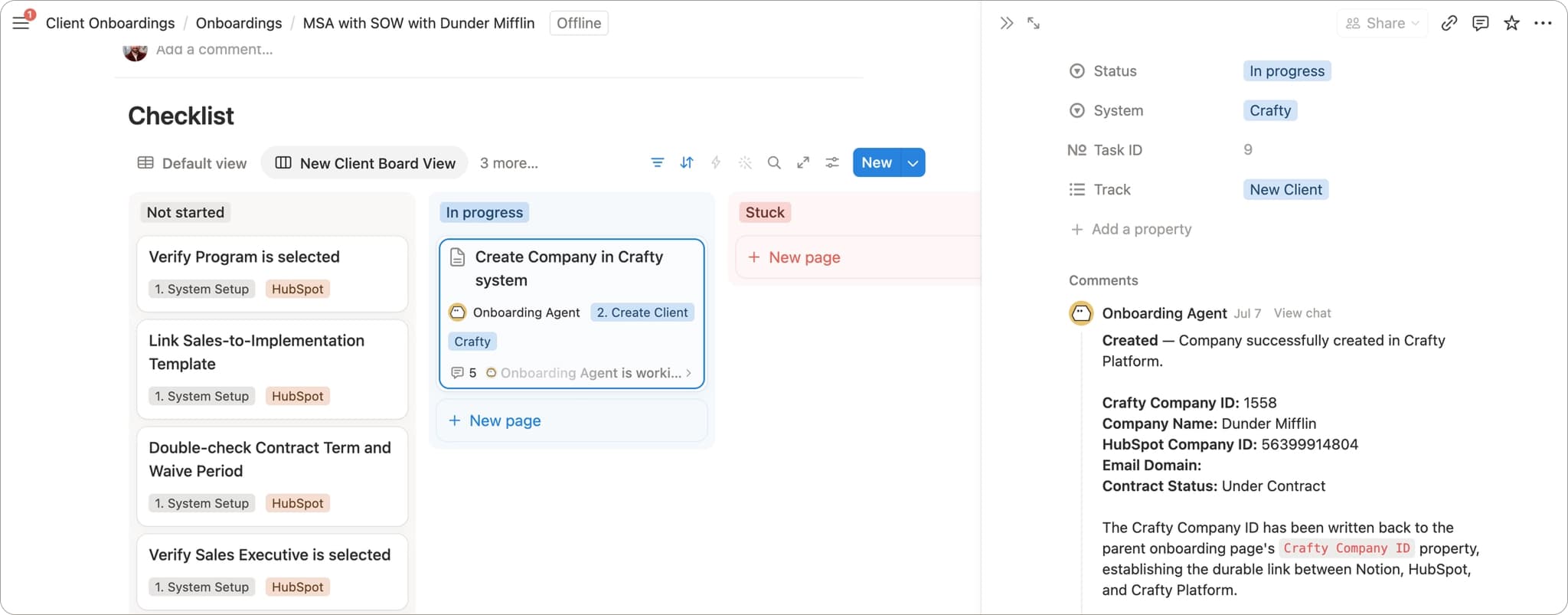
Third, we are applying the same pattern to new client onboarding. A completed contract in Ironclad can trigger a Notion Worker to create the onboarding tasks in Notion. From there, an External Agent can take a task like “create a company in Crafty,” check the systems it needs—HubSpot, the Crafty platform, and Notion—and comment back when the work is done.
We are starting with simple steps, then expanding into more complex onboarding work like contracts, locations, budgets, and payment profiles. This will save thousands of hours per year across our teams.
Step 4: Give people one front-door agent to make adoption easy
As we added more agents, we ran into a new problem: people needed to know which agent to use.
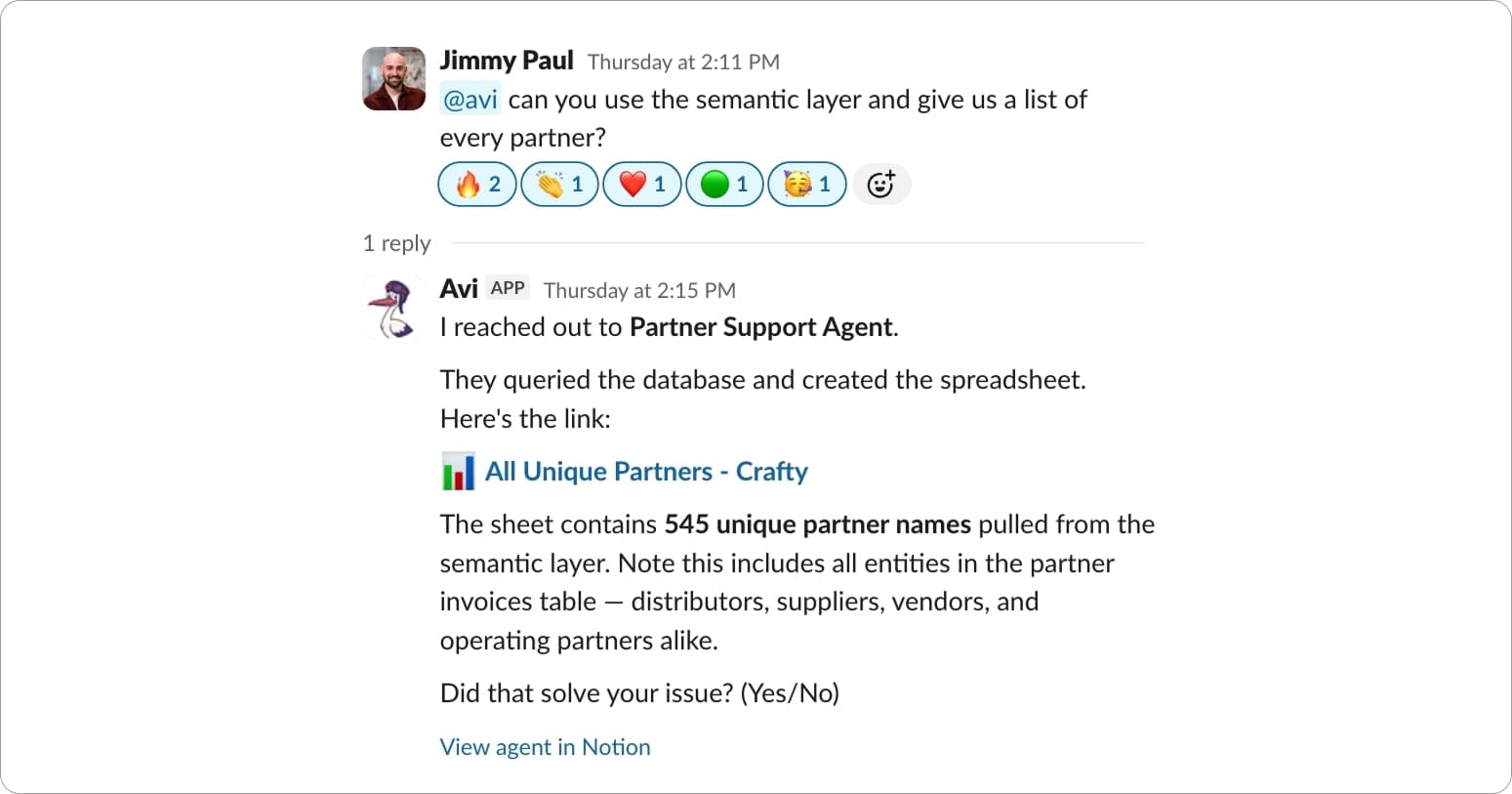
That is what Avi is for. Avi is our front door for any request. It does not try to do everything itself. It figures out where the request should go.
We are consolidating roughly 20 internal support channels into one channel where Avi can field questions and route them to the right support agent, execution agent, person, or team. If a question needs a specialist, Avi sends it there. If it needs a person, Avi pulls them in. If it can start a workflow, Avi kicks off the next step.
That is where the system starts to feel different. AI is not a separate tool people have to remember to use. It becomes part of how work moves through the company.
Step 5: Connect agents to external systems for more complex tasks
Answering questions was only the beginning. The bigger opportunity is helping agents complete well-defined work.
In software development, small tickets used to wait in an engineer’s queue: cleaning up old feature flags, migrating a deprecated Storybook API, adding a reporting column, or building a small UI filter someone in Ops requested. These were useful tasks, but they often lost priority to larger engineering work.
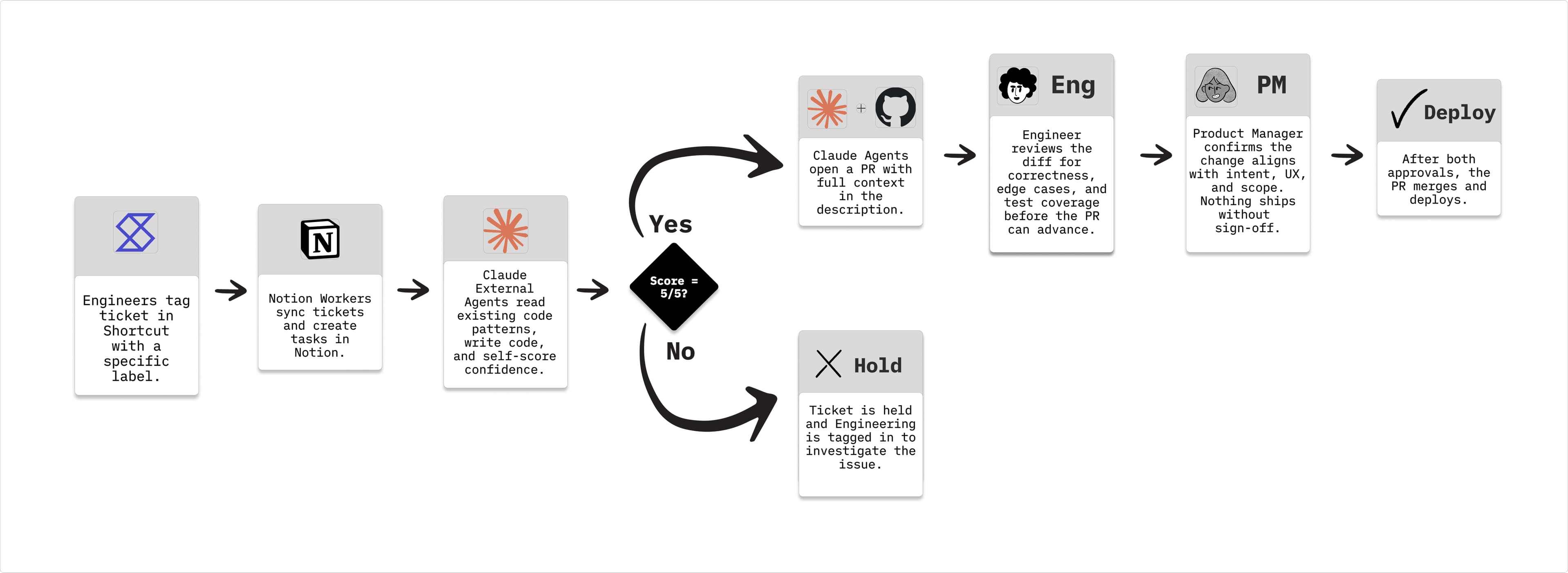
Now, an engineer can tag any of their tickets in Shortcut to be handed off to an agent. A Notion Worker brings that ticket into a Notion task database. A Claude-powered External Agent reviews the ticket, checks our code patterns, makes the change, and opens a pull request in GitHub.
We keep the guardrails simple. The agent scores the ticket based on confidence and risk before it acts. Only tickets with a combined rating of 5 out of 5 move forward to a pull request. Every PR still gets human QA and product review before it merges.
Based on our pilot, we estimate we will free up 730 engineer hours a year. Some tickets can now be completed in as little as 20 minutes.
What we learned while building AI agents
Agents only work when the operating model around them works.
For us, that meant starting with clear documentation, giving every workflow an owner, using templates and databases to make work repeatable, and reviewing agent output so the system keeps improving.
It also meant keeping oversight in place. Teams should be able to build and improve agents, but they should not have to manage every connection, version, cost, and risk on their own.
That is why Notion has become so important to us. It is where the work is documented, where tasks are tracked, where agents operate, and where humans review what needs judgment.
The biggest shift is simple: our documentation no longer just explains how the business works. In Notion, it helps the business get work done.