
As EMEA GM, I meet companies of all sizes and sectors across a diverse region. When I ask how we can help them achieve more, the conversation almost always turns to AI.
Every day, teams are testing new ways to use AI and learning where it can make the biggest difference. We wanted to understand that impact more clearly.
We surveyed more than 6,000 knowledge workers—that is, people who work primarily in computer-based roles—across the UK, France, and Germany about how they’re using AI and its impact on their day-to-day. They told us that AI is changing the shape of work itself, from the skills people need to the value they can create.
One group stood out: people using AI every day. Their regular, incremental wins and learnings have become daily habits, rather than ad-hoc experiments. Of those we surveyed, everyday AI users are far more likely to report stronger career prospects for their own futures. And it’s largely the same picture across different company sizes and markets.
The everyday AI advantage
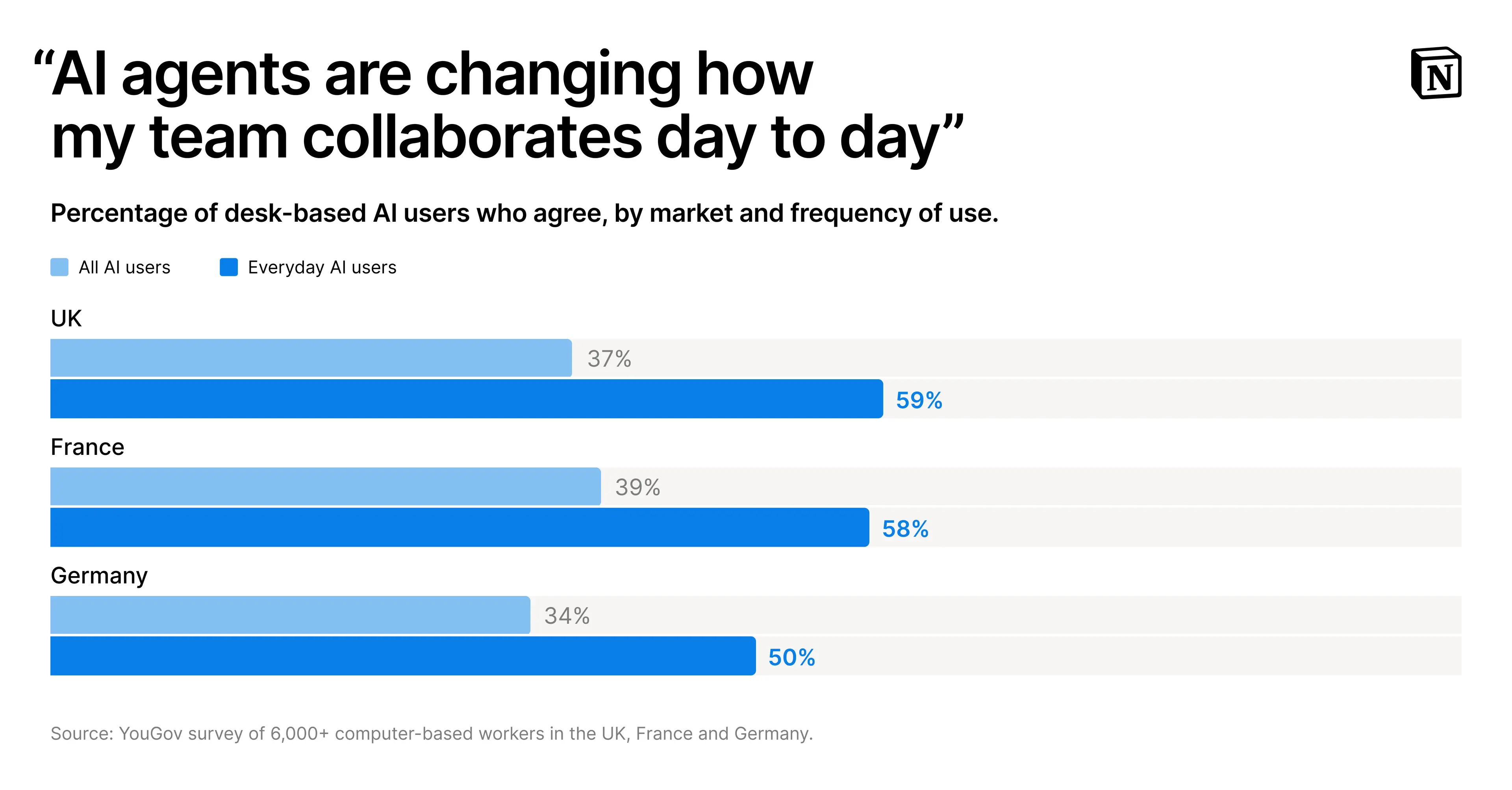
We asked people how AI is affecting their work. Across all three markets, daily users are seeing the most impact. Firstly, AI agents are changing how respondents’ teams collaborate: in the UK, 37 percent report this, rising to 59 percent among daily users; in France, 39 percent, rising to 58 percent; and in Germany, 34 percent, rising to 50 percent.
Daily AI use is also reshaping how decisions get made. Over half (59 percent) of daily AI users in the UK say AI agents are changing how decisions are made in their organisation, compared with 38 percent overall; in France, that's 53 percent versus 36 percent, and in Germany, 48 percent versus 30 percent.
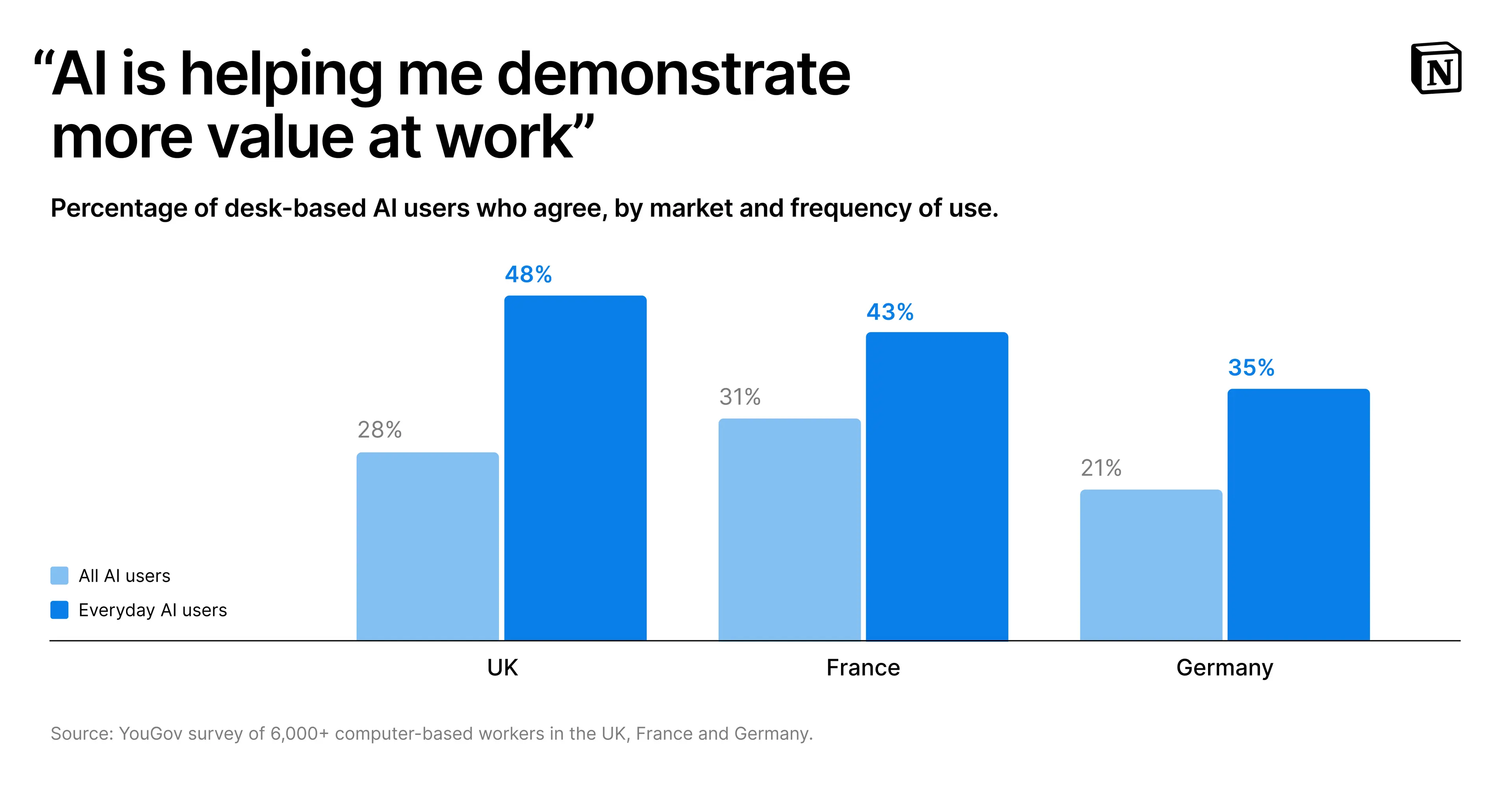
In the UK, a quarter of AI users say AI is helping them demonstrate more value at work. Among daily users, that nearly doubles (48 percent). It's a similar story in France, from 31 to 43 percent, and in Germany, from 21 to 35 percent.
Daily users are also more likely to say AI is improving their roles and career prospects. In the UK, 44 percent report this, compared with 25 percent overall. The pattern holds in France (39 versus 24 percent) and Germany (34 versus 22 percent).
Gen Z is redefining early-career work
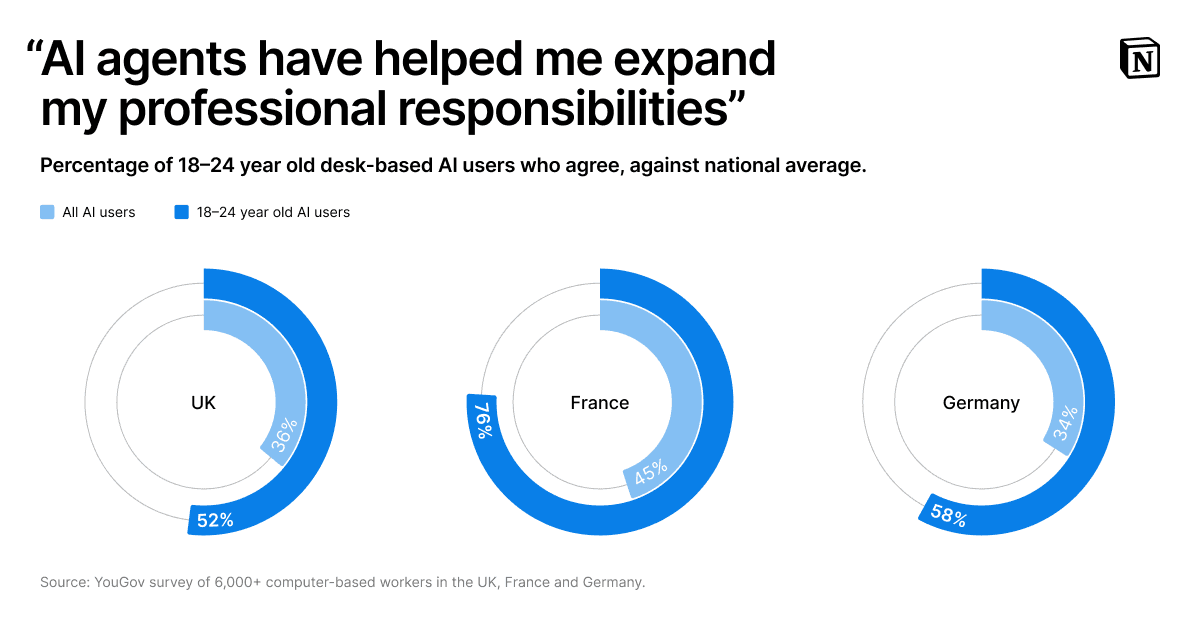
The future is bright for those who can adopt AI tools quickly and with an open mind. More than half of 18- to 24-year-olds in the UK (52 percent) and Germany (58 percent), and three quarters in France (76 percent), say they are using AI agents to expand their professional responsibilities. I see this builder mindset among people early in their careers at Notion, where AI is helping them take on new challenges and broaden their impact.
But these opportunities also come with more uncertainty. Younger workers report they are more concerned about what it means for job security. This was highest in Germany, where concern about job security was 21 percentage points higher among 18- to 24-year-olds than the German national average.
Rethinking work end-to-end
AI is still used largely by individuals, rather than built into how teams work together. Only 22 percent of respondents in the UK, 21 percent in France and 18 percent in Germany say they are embedding AI agents in team-wide systems or workflows.
So while daily AI users are busy growing and adapting, they’re largely doing it in silos with their own processes, shortcuts, and their own private context. The gains are real, but they stop at the edge of each person’s desk.
Some of Europe’s fastest-growing companies are already showing what happens when AI becomes part of how an entire team works. At Pennylane, around 600 Custom Agents handle more than 2,000 workflows each day. Brainlabs uses Notion AI to turn meeting decisions into action in a matter of minutes. And at Parloa, teams around the world use AI-powered access to organisational knowledge to make better decisions, faster—helping lay the foundations for fivefold employee growth.
These companies are succeeding by rebuilding everyday AI tasks around shared workflows and company context, so teams can think together. That’s the next step for many companies, and it’s closer than you think.

About the research
YouGov surveyed more than 6,000 computer-based workers in the UK France and Germany. Breakdown of sample size included below:
UK: 2,063 computer- based private sector workers, of which 1,379 used AI agents
France: 2,064 computer- based private sector workers, of which 1,542 used AI agents
Germany: 2,067 computer- based private sector workers, of which 1,554 used AI agents
Fieldwork was undertaken between 9-19 June 2026.
AI agents refer to AI tools that can complete tasks, make decisions, or take actions on your behalf such as drafting communications, summarising documents, conducting research, or managing workflows.