
簡介
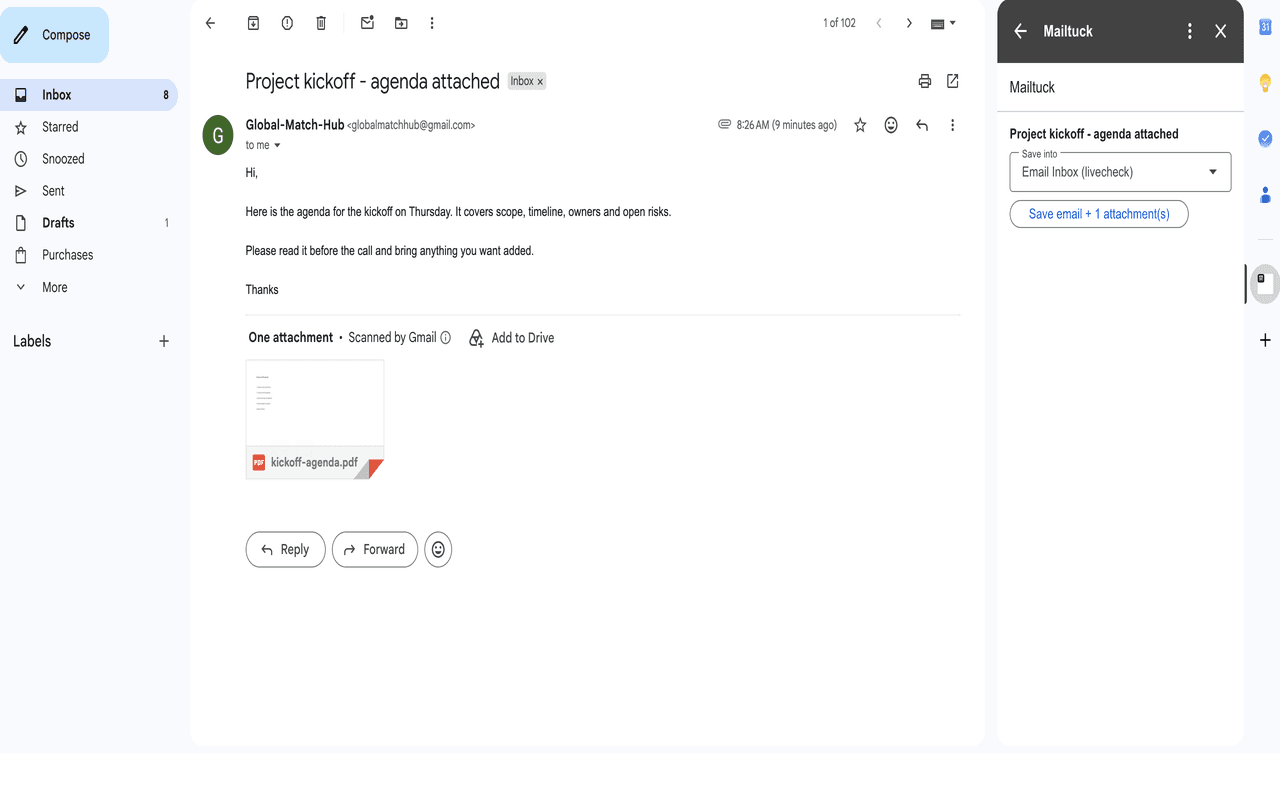
Reading an email you want to keep? Press one button and it becomes a page in your Notion database: subject, message text, and the attachments too.
Why another one
Most Gmail-to-Notion tools were built before Notion's API could upload files at all. They either drop attachments or paste a link that expires. Mailtuck uploads the file into the page, so the thing you actually needed is still there next year.
What you get
- One-click save from the message you have open
- Attachments uploaded into the Notion page itself
- Pick any database you have connected; the title, sender and date map to its columns
- Files too large for your Notion plan are named in the page with the reason, never dropped in silence
- Errors written as instructions ("reconnect Notion", "share the database"), not error codes
What Mailtuck cannot see
It reads only the message you have open, using Google's narrow contextual permission. It has no access to the rest of your mailbox, your Drive, your contacts, or your calendar. Those permissions are absent from the add-on, so it cannot use them even if asked. Your Notion token is stored per user inside Google's own add-on storage; we run no server that could hold it.
Mailtuck is an independent product and is not affiliated with, endorsed by, or sponsored by Notion Labs or Google.
功能
- 讀取、插入和更新內容可以讀取、插入和更新此連接共享的頁面、資料庫和區塊。
- 查看工作空間使用者讀取工作空間成員與訪客的基本個人檔案詳細資料。
使用方式
1. Install Mailtuck from the Google Workspace Marketplace and open Gmail.
2. Open the Mailtuck panel and press Connect Notion. Choose your workspace. There is no key to copy.
3. In Notion, open the database you want to save into and grant Mailtuck access there (⋯ → Connections). Notion hides every database from every add-on until you do this.
4. Back in Gmail, open any email, pick the database, and press Save. The page appears in Notion with the body and the attachments.
Tip: on Notion's free plan each file must be under 5 MB. Anything larger is named in the page with the reason instead of being dropped silently.