How Morning Brew Turned Every 'Sigh' Into an Agent
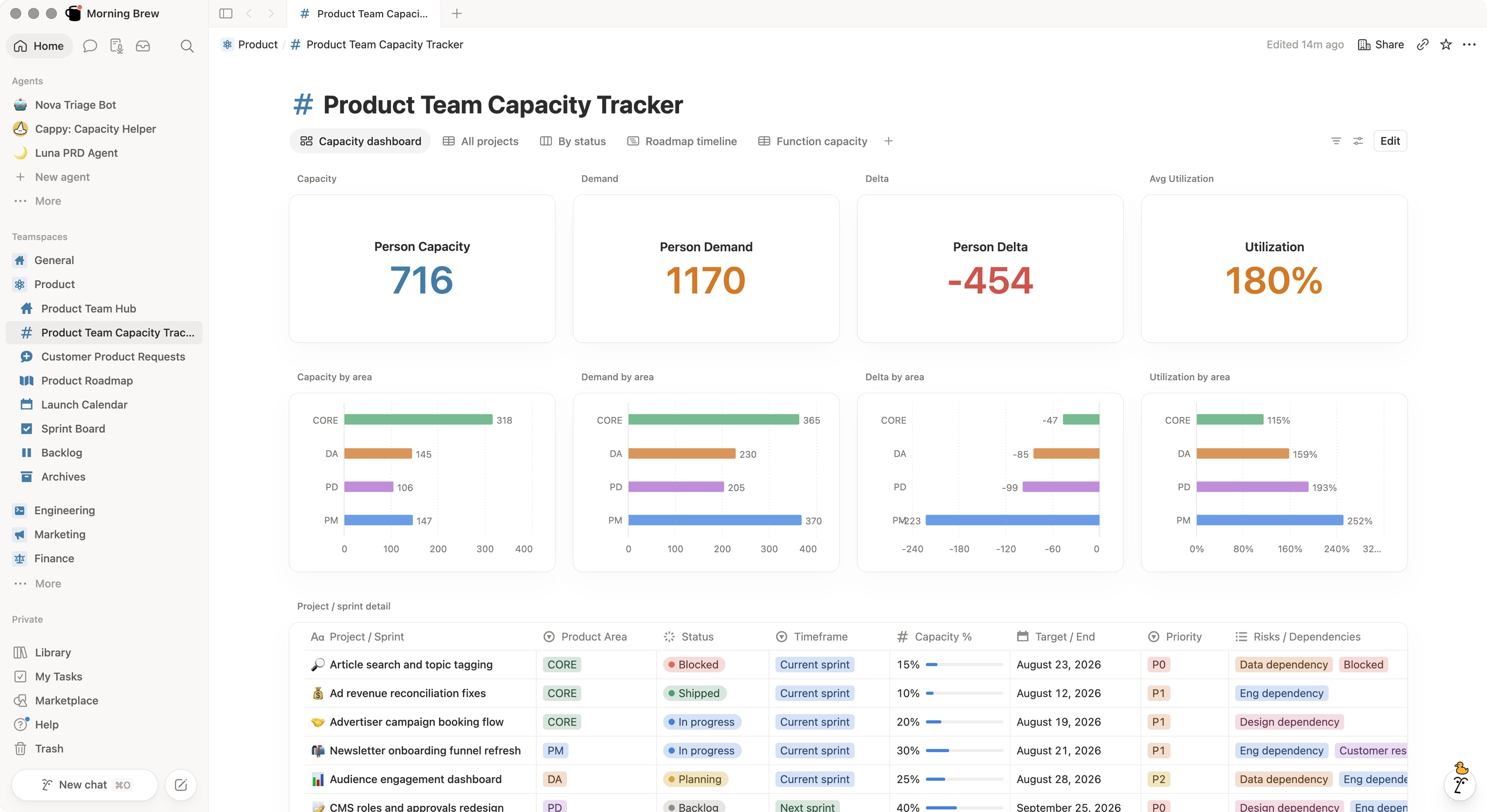
After five years of running the company on Notion, Morning Brew stopped treating AI as a personal productivity trick and started building a shared operating system — a network of Custom Agents (Nova, Cappy, and Luna) that quietly handle the connective work of a fast-moving media company, freeing people to focus on judgment while the whole team's progress compounds.
The moment Notion became non-negotiable
Morning Brew—officially Morning Brew Inc., the media company behind its newsletters, podcasts, and video—has been building in Notion long enough to know the difference between a tool you use and a system you run on.
Before the pandemic, the company used Notion unevenly. Some teams, like product, loved it; others ignored it. But around 2021, there was a deliberate shift: Strategy & Ops mandated Notion as the company-wide wiki, department heads were trained, and standards were set and enforced.
The result wasn’t just more pages. It was a new critical, reliable business operating system: PRDs, capacity planning, and wikis all living in one place, followed by five years of sustained, deep use.
That foundation matters, because Morning Brew’s AI transformation is about what happens after you already have a real source of truth. Once everything lives in Notion and all apps are connected, AI agents stop being a personal productivity trick and start becoming a shared business system the whole team can rely on.
There were conversations in Slack, work in Linear, notes in Notion, and 1:1 updates in Google Docs. And none of it talked to one another.

Why Custom Agents, why now
Morning Brew didn’t start with a grand vision of AI everywhere. The catalyst was a problem that needed solving: a partnership event created urgency to identify a handful of real, demo-worthy workflows. Instead of talking about AI in the abstract, the team needed to quickly show how it could reduce friction inside the company.
A useful framing emerged in the process. As Emily says, “Whenever I deep sigh about a task, I ask myself, ‘Can I delegate this to AI?’” And whenever the task requires gathering context and creating some kind of output in Notion, Custom Agents are the natural answer.
Synthesizing information? AI can do that—that's not where my value is. My value is in what I do with the synthesized information: the understanding, the judgment, the action.
Three ongoing tasks, three agents
Morning Brew’s agents have purpose-built roles; each is designed around a “sigh”—a recurring moment where the team was spending time doing work that didn’t actually require human judgment.
Nova: a CMS helper that turns interruptions into a workflow
Publishing organizations run on speed, but they also encounter constant, low-grade interruption: “Is this a CMS bug?” “Where’s the right doc for this?” “How do I resolve this issue?” These questions tend to land in on of three support Slack channels—leading to context switching, repeat explanations, and bandaids that might not graduate to real processes.
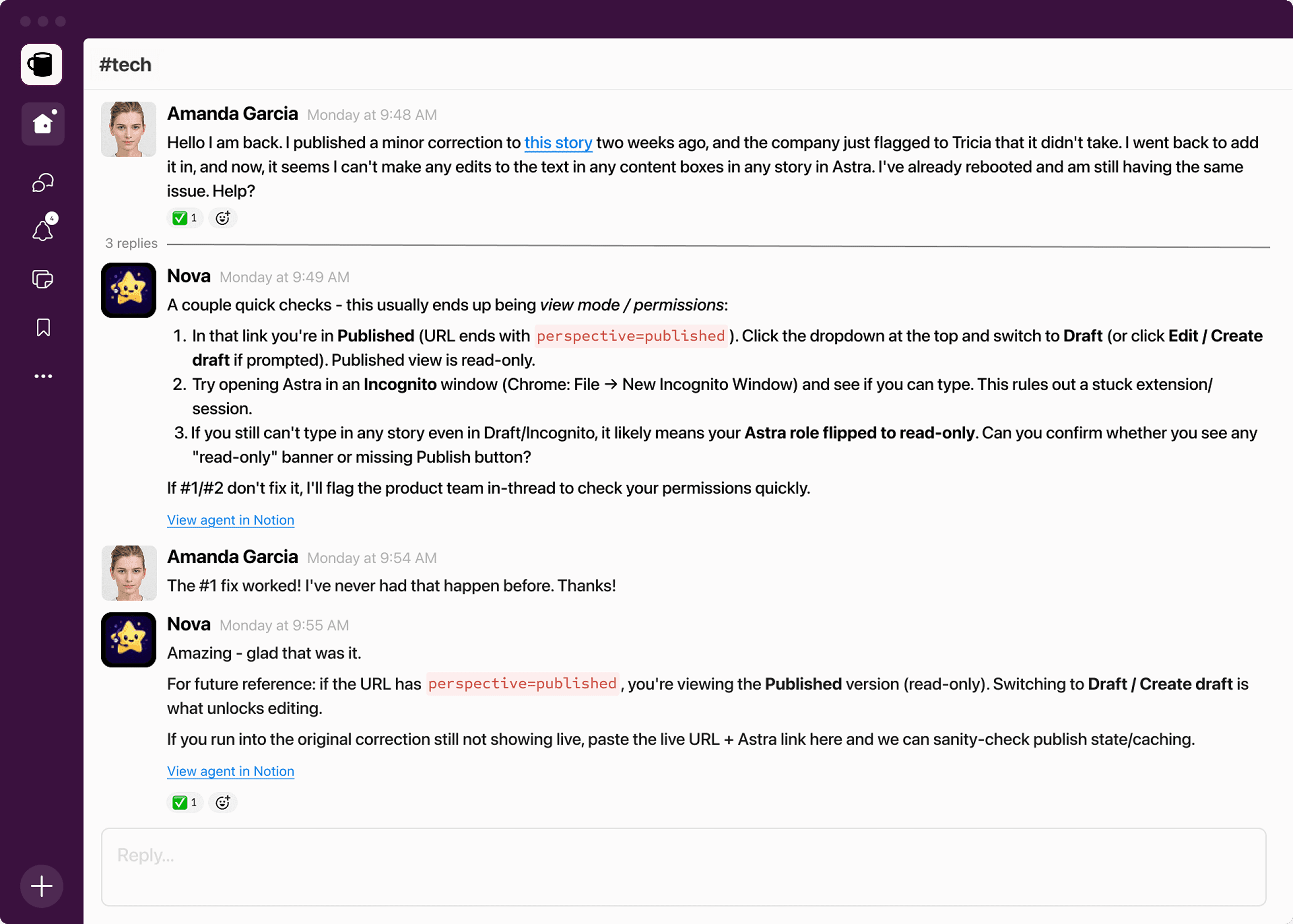
Nova was built to handle that pattern. It monitors designated Slack support channels for publishing/CMS questions, responds in-thread using documentation-based answers, and logs each issue into a Notion ticket database. Even non-technical Morning Brew staffers like it, since Nova gives them immediate, well-thought-out answers in plain English.
Since Nova launched, about 20% of inbound issues have been either “Advanced by Nova” or “Resolved by Nova”—meaning that one in five questions never turns into a full context switch or support ticket for the team at all.
But as the Notion ticket database suggests, Nova also creates a helpful paper trail. That matters because it turns support from a series of one-off rescues into something the team can track, learn from, and improve. Over time, it reduces the burden of answering repetitive questions manually, and it makes the “small” problems visible enough to actually address.
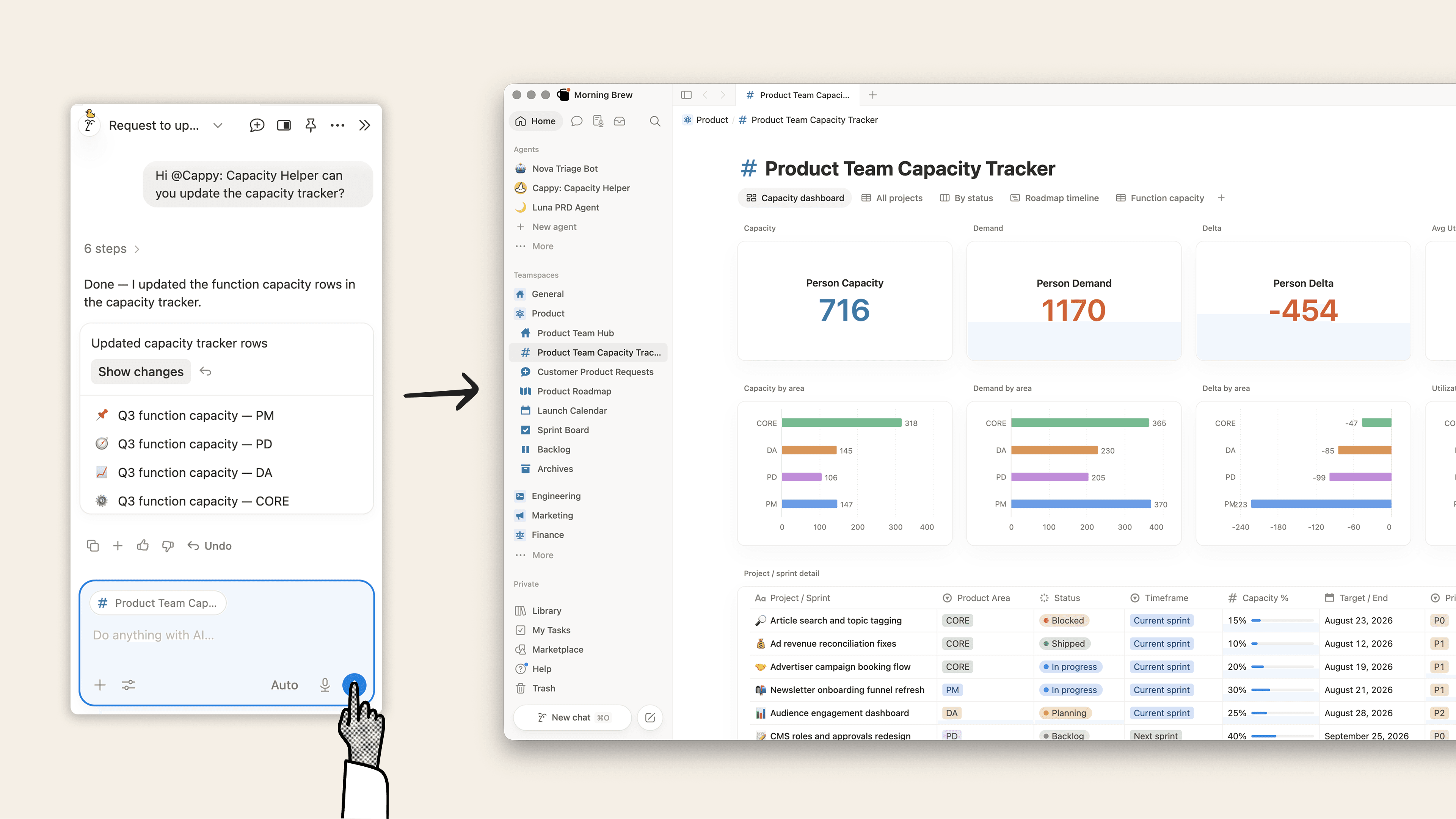
Cappy: capacity planning without the spreadsheet
Product organizations rarely scale headcount at the same pace as roadmap ambition, and Morning Brew's product org—split across four functions—felt that gap directly. Knowing which function was overallocated meant Emily manually pulling capacity numbers into Excel every time the roadmap shifted: a recurring, error-prone chore with no single source of truth.
Cappy replaces that spreadsheet. Run automatically or on demand when a change is made to a project, it pulls capacity information straight from each product's entry in the Notion Roadmap, then calculates utilization percentages across the four product functions and flags any team that's overallocated—recently catching the data analytics engineering team running at 250% capacity.
Like Nova, Cappy isn't meant to replace judgment about how to rebalance the work; it's meant to remove the manual math that used to come first. Because the numbers already live in the same Roadmap the team plans against, what used to take Emily roughly an hour in Excel each cycle now takes about five minutes with Cappy—12x faster.
It's a smaller agent, but it's built on the same instinct: find the recurring “sigh,” and let an agent do the counting so people can spend their time deciding what to do about it.
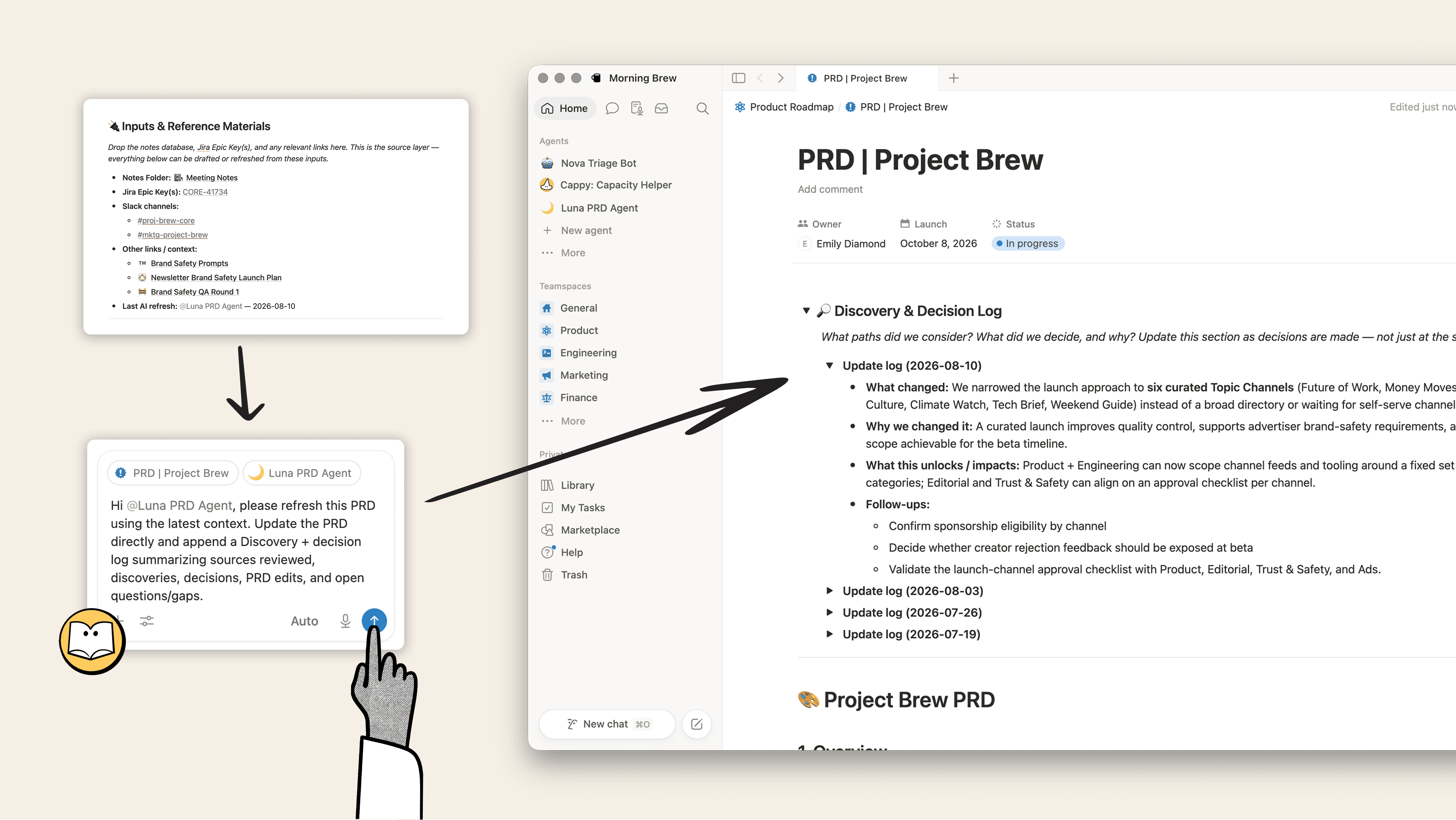
Luna: a living PRD (and a living decision trail)
If Nova and Cappy handle the day-to-day friction of operations, Luna goes after something more existential for product teams: the fact that PRDs go stale moments after they’re written.
Luna to keeps PRDs alive by pulling in updates from four sources: meeting transcripts, Linear, and relevant Slack channels and Notion pages. Each time it runs, the agent generates an updated PRD and, importantly, a discovery-and-decision log.
The point isn’t to create more text. As Emily puts it, the goal is to “remove the mental wall between a great conversation and a shareable artifact.” Or, more bluntly, “I like talking, I don’t like writing.” Luna enables that focus. It ensures that PMs don’t have to spend their best hours doing synthesis and cleanup, yet new team members or any leaders checking in only occasionally know they are seeing current information.
The “Agent OS” is really about compounding
Morning Brew didn’t just adopt AI. They’ve built a operating system (OS) of agents that, working alongside humans, compounds everyone’s progress.
That’s what makes Morning Brew’s AI transformation feel durable—and what makes it especially resonant for a media company. Morning Brew’s work is high-velocity, cross-functional, and responding to changes in the media environment (and the wider business world). The goal is moving fast without losing the thread.
Agents make sure the thread isn’t lost. And when synthesis, logging, and first-pass documentation become cheap, the team’s roles, from leader to individual contributors, gets clearer. People spend time on understanding, judgment, and action. Agents handle the rest. Together, humans and agents contribute to a kind of operating system that, over time, helps the company get smarter, sharper, and speedier.
That same pattern is playing out across the team, and the boundaries between functions are getting productively blurry in a way that's making us faster and closer.