How Candidly uses Notion to make Cursor agents multiplayer and ship 73% more value
Candidly’s Product team uses Notion in two innovative ways: to manage coding agents in a shared surface, and to write product-facing documentation with agents that read the codebase. That helps the product team deliver at incredible speeds while giving Sales, Customer Success, and Support a current place to find product answers.
Two workflows accelerating value delivered at Candidly
Candidly exists to help people crush debt and build wealth. Its AI financial coach, Cait, supports decisions across student loans, budgeting, savings, benefits, and retirement.
To keep improving that experience, Candidly needed to solve two connected problems: help a lean team move ambitious software projects forward, and keep product knowledge accurate as the software changed.
Ben Levine, Candidly’s Chief Product Officer, brought both workflows into the same shared workspace:
Coding agents work out of Notion to ship new products, using the team’s context to maintain quality.
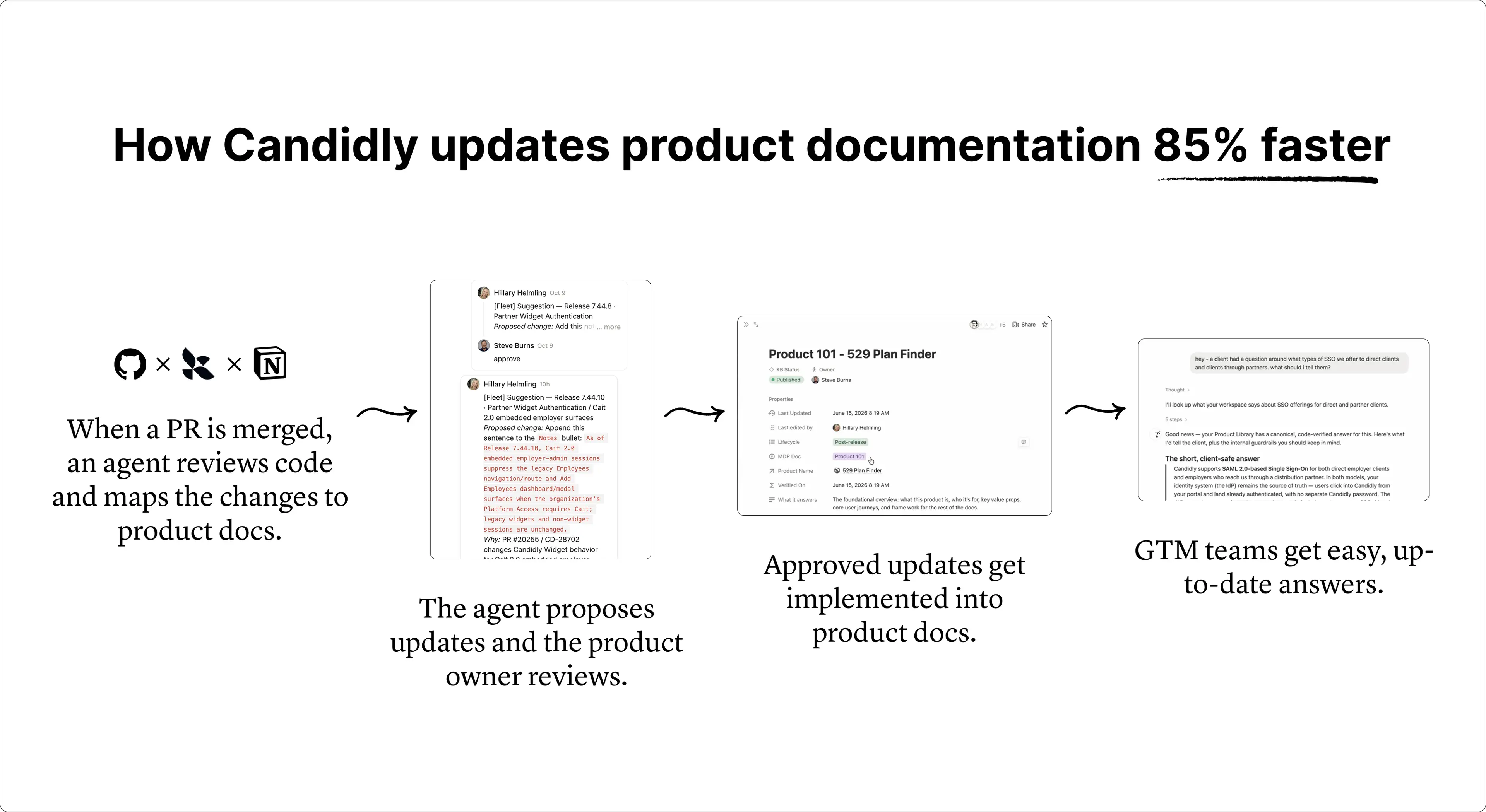
Agents write into Notion to maintain the product documentation, reading straight from the codebase.
The result is more value delivered to customers, with the ability keep the team enabled and supported on the company’s technical product.
Notion isn’t just where our documents live anymore—it’s where the work happens.

Hov! Det ser ud til, at din reklameblokker forhindrer videoen i at blive afspillet.
Se den på YouTube i stedet

One collaborative, context-rich surface to manage coding agents
One of Candidly’s upcoming projects is a public benchmark to measure different agents’ ability to take financial actions—like canceling a subscription, finding a better loan offer, or transferring funds safely.
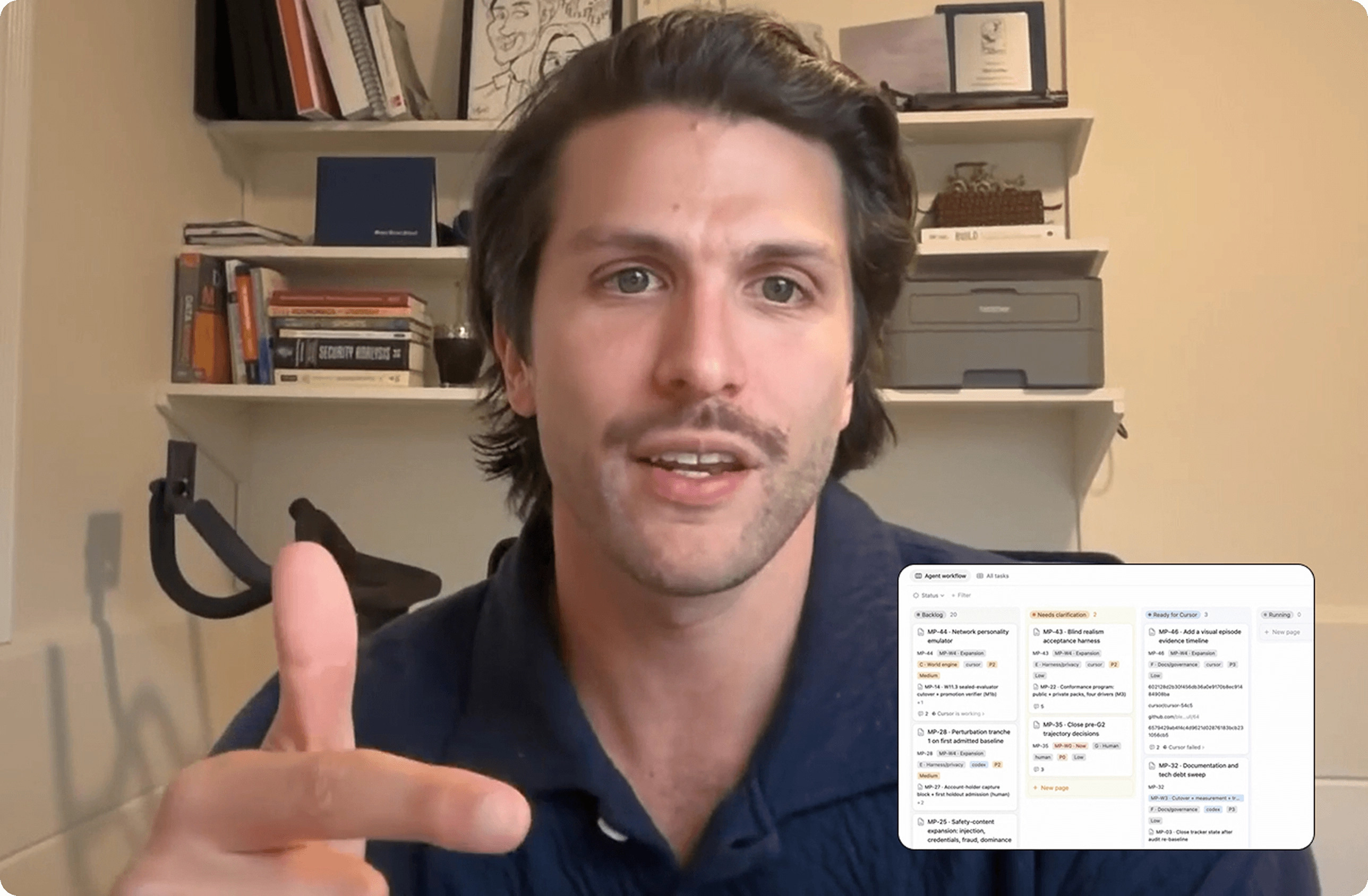
They’re using a Notion task board to manage Cursor agents in a multiplayer environment: product, engineering, and coding agents can see the same tasks, context, and decisions as the work moves forward. Because this particular project is complex and high-stakes, every task needs clear criteria, careful sequencing, and human visibility.
Each ticket links the objective and acceptance criteria to the PRD, decisions, meeting notes, and product documentation behind it. Ben can then launch a Cursor coding agent with the same context the team uses, so it understands both what to build and why.
From one board, Ben can:
See which tasks are ready, active, blocked, under review, or complete
Inspect an agent’s progress and respond inside the ticket
Pull in a colleague without losing the project history
Step in when the work needs a product decision
Building this way has reduced the time it takes to deliver a full user story by about 10 days, making development 41% more efficient. Now they’re spending more time deciding what to build and QAing code—in other words, making sure what’s delivered is valuable.
Candidly is taking the idea further by testing agents that manage parts of the board itself. They can evaluate finished work, advance a dependent ticket, and involve Ben only when judgment is required, so work continues overnight without becoming invisible.
Hov! Det ser ud til, at din reklameblokker forhindrer videoen i at blive afspillet.
Se den på YouTube i stedet
Every PR merge keeps product documentation current
Previously, PMs had to translate code changes into product explanations and remember every internal guide that might need an update. Candidly wanted documentation to begin with what the product actually does, not relying on a busy person’s memory.
During a three-day sprint, Ben created “code-based treasure maps”: markdown guides that point agents to the files, services, and concepts behind each product area. This sets up agents to navigate the codebase efficiently.
Then, PMs used Cursor, Claude Code, and Codex to draft a consistent product library directly from the code, covering how each capability works, what different teams need to know, and what changed recently.
Two people independently reviewed every initial page before it became canonical. Now, agents built with LangSmith Fleet inspect every merge to develop, identify affected pages, and propose section-by-section edits. A document owner approves, rejects, or changes each proposal before it becomes the new source of truth.
PMs spend roughly 90 minutes per week reviewing documentation work, down from about 10 hours spent repeatedly reconstructing and rewriting it.
PMs get a full day back each week with this new method of maintaining product docs. They can spend the time on fun, impactful work instead of documentation.
GTM gets product answers without waiting on a PM
The validated library gives every team a faster path to the product truth. Sales can prepare for a customer conversation, Customer Success can check program behavior, and Support can trace an answer back to its source—without waiting for a PM. The same answer can become customer-facing material, like a Candidly-branded slide, without another multi-team handoff.
The speed comes with accountability: every answer points back to maintained, reviewable documentation with a clear owner. PMs can focus on the roadmap and material changes instead of routing every product question.
A leaner team ships 73% more value per person
Ben combined planning data, Jira tickets, and GitHub commits to measure customer value delivered over time. His analysis found that Candidly’s EPD organization shipped 73% more value per employee after adopting agents—even as the team became more than 25% smaller. This was not more code for code’s sake; it was more meaningful work reaching customers.
The model also makes previously impractical ideas possible. One effort to make Cait’s calculations more verifiable became a published research paper and influenced Candidly’s approach to user guidance. The public benchmark for financial-action agents is another multi-month idea Ben can now advance asynchronously instead of leaving it on a “someday” list.
More capacity to improve people’s financial lives
Candidly has generated more than $2.5 billion in impact on users’ finances. For Ben, that mission is the point: Less time maintaining documentation and coordinating routine work means more capacity to improve Cait and help people move from debt toward wealth.
Next, Candidly wants to make more projects multiplayer—bringing Product, Design, Engineering, and agents into the same visible project state. People set direction and make judgment calls; agents handle bounded implementation and maintenance work. Decisions, context, and results stay connected as the work moves forward.
Ultimately, what fuels me is helping people crush debt. This lift allows us to push that mission even farther, even faster.