
Clay’s New Default: Workflows That Happen in the Background
Clay centralized their work in Notion, then rolled out 80+ Custom Agents in a week to turn that context into action—automating triage, incident response, and daily briefings and running dozens of workflows in the background. In other words, their workspace does not just store knowledge. It routes work.
When critical context is scattered
Willie Yao would find out about customer issues hours after they’d already escalated. Someone would ping him about an urgent bug, and when Clay’s Head of Engineering looked into it, a critical customer would have already grown frustrated due to the delay in response. Details were in a Slack channel somewhere, but Willie couldn’t monitor every thread personally.
Meanwhile, Yash, who runs education and community, was spending hours a week wading through call transcripts, searching for customer insights and ideas for thought leadership content.
Both problems had the same root cause: Valuable information existed in Clay’s tools, but in a completely unusable state.
The irony wasn’t lost on them. The company that helps go-to-market teams automate manual data work is bogged down by the exact kind of coordination overhead they help customers eliminate.
With Notion, we're always just one question away from being on the same page.

Custom Agents that route work automatically
Clay had already consolidated work in Notion—meeting notes, projects, documentation all in one place, connected to Slack and Google Drive. Teams used Notion AI to find information, and new hires were told to check Notion AI before asking questions in Slack. The information was accessible. The problem was making it actionable.
Custom Agents solved that. Since all of Clay’s knowledge was already managed in Notion, Custom Agents have the context they need to take meaningful action and handle workflows that previously required manual effort:
Meeting Classifier takes Yash’s meeting transcripts, categorizes them by type (1:1s, team meetings, all hands), and routes the content accordingly. For instance, 1:1s add context to ongoing personal docs, while team meetings update the team task database. The right updates, all without manual input.
Incident Manager gives Willie instant context on any production issues. It monitors Slack channels and synthesizes the underlying issue, current status, who’s involved and what next steps should be. “We realized that Custom Agents often do a better job when it comes to understanding what the root cause is and what the best corrective actions are,” Willie says.
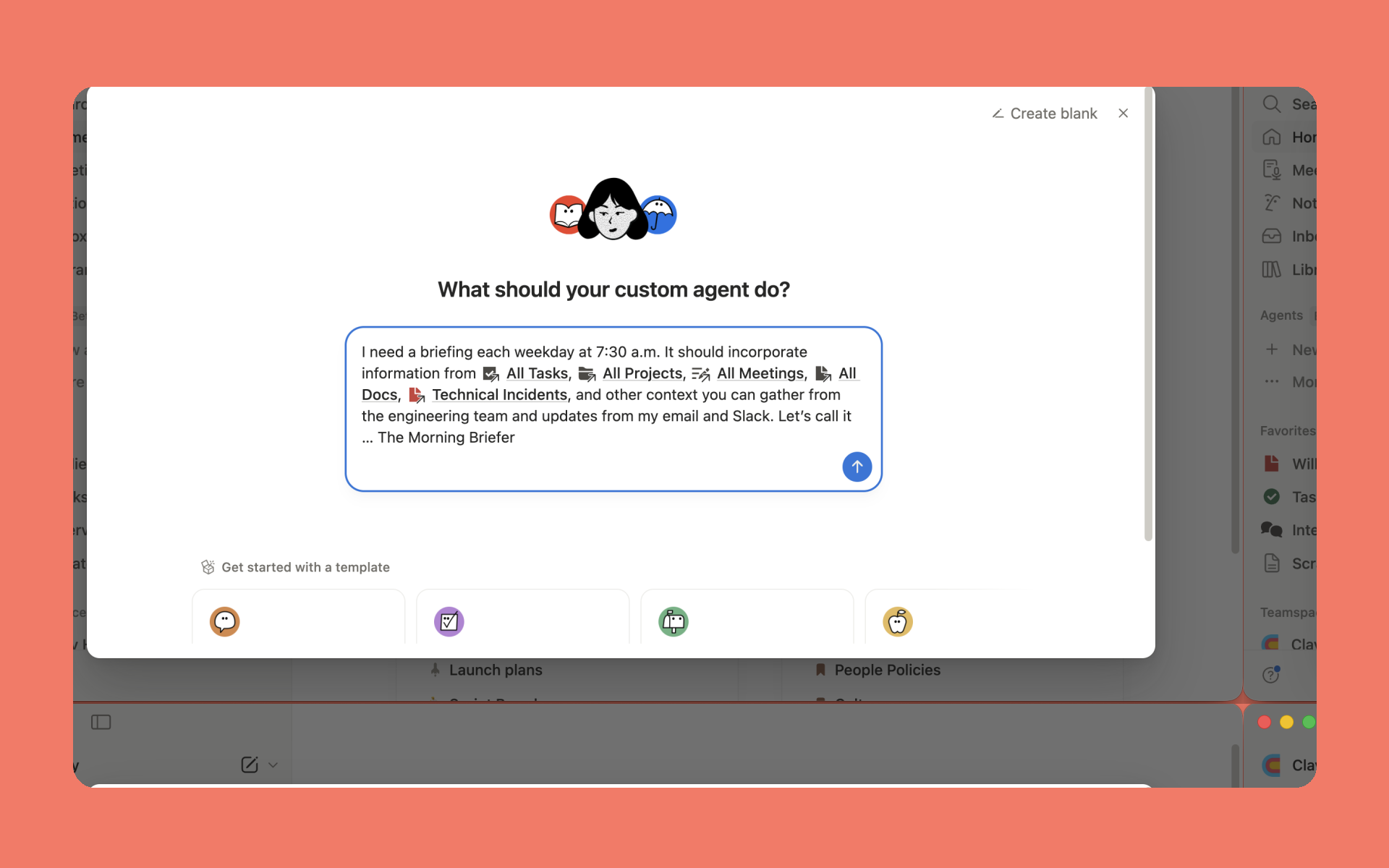
Daily Briefer scans all of Engineering’s work every morning and pushes Willie everything he needs to know: Active bugs, ongoing incidents, upcoming launches, meetings to prep for, and more. “People are surprised about the amount of context that I have,” he says. “It’s because I have this Custom Agent that’s always looking out for me.”
To build all this, Yash expected the usual configuration hassle that AI tools often require. He didn’t find it. “I was shocked at how simple it was to set up a Custom Agent,” says Yash. “I connected Slack, set up a prompt, and I was able to test the results in five minutes.”
Within a week, they had rolled out 80+ Custom Agents across the entire company that were already running dozens of workflows on their own. No hand-holding, no nudging.
What actually changes
For Willie, the impact he sees with Custom Agents isn’t just efficiency. “Before, I was very reactive—mostly responding to things I was tagged in,” he says. “Now, Custom Agents push information to me that I simply wouldn’t have known otherwise. It’s not even about saving time. It’s about having information I wouldn’t have had.” That information changes how he operates as a leader. He’s able to stay connected to the work, even as the engineering team scales.
For a fast-growing startup, staying connected at scale usually means more process, more meetings, and more overhead. But Clay is building it differently thanks to Custom Agents. The coordination work that typically slows things down now happens in the background. “A lot of scaling comes down to doing things consistently,” Willie says. “And those are the things we can codify into Custom Agents.”
And adoption has been entirely word-of-mouth. “People will ask me how I’m tracking everything. The answer is simple: Custom Agents handle it,” Willie says. Once someone sees what’s possible, Yash says it sparks all kinds of ideas for other ways to use them.
At this point, it’s not an experiment. It’s how Clay runs. If your team is trying to make the same shift from scattered updates to workflows that run on their own, Notion can help you map the path.
Asked to sum up Custom Agents in one word, Yash didn’t hesitate: “Crazy.”

Part of what makes custom agents so powerful is that they not only structure data, they can take action on it.