From Writing About AI to Building With It: How Every Accelerated Growth with Notion
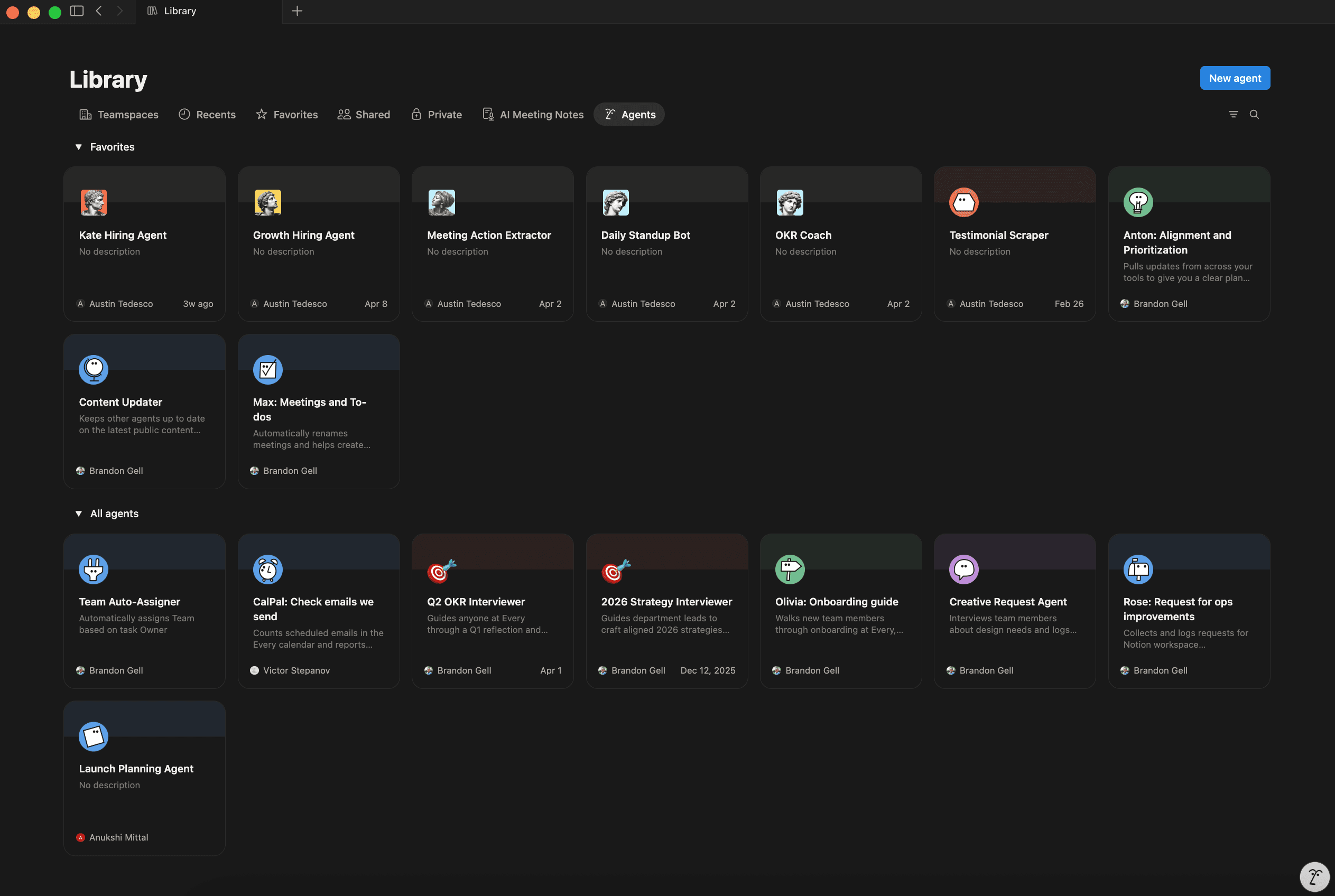
Every is an AI-native company that treats agents like teammates—and to make that possible, they centralized their work in Notion so agents could actually access the knowledge, run the workflows, and keep the company moving. This story covers how a 20-person team uses Notion as the operational layer across growth, planning, and execution—pairing always-on Workers with Custom Agents that turn scattered metrics and context into daily, actionable decisions.
Meet the least “technical” person powering the most technical workflows
Austin Tedesco will be the first to tell you he’s not a developer. He’s a former-line-cook-turned-business-development guy who joined Every because he couldn’t believe what the team was building. “I was so excited to be the dumbest person in the room,” Austin says.
Every is an AI company with a daily newsletter, a podcast, a suite of AI productivity apps, and a consulting business—all run by a 20-person team with about 30 AI agents working alongside them.
Austin runs growth, and despite the army of agents, he’s never once typed instructions into a Notion Custom Agent’s settings. He describes what he wants to Codex or Claude Code, and it builds the agent, the workers, and the databases for him—then copies the instructions to his clipboard. All Austin does is hit paste.
His Notion databases aren’t built for the team. He barely even looks at them. But those databases power everything about how Every works.

The problem wasn’t productivity—it was accessibility
When Austin joined Every as Head of Growth back in November 2025, the company had Notion but wasn’t organized around it. Engineering was in, marketing mostly lived in Google Drive, and the usual amount of critical context was happening (and evaporating) in Slack.
At most companies, that’s an annoyance. But teams survive it. At Every, it was a complete blocker. They treat agents as equal partners in the workplace, and agents can’t do their jobs if the knowledge they need is scattered across tools they can’t reach.
“No one at this company should do computer errands,” says COO Brandon Gell—those repetitive tasks that drain your energy before you get to work that actually matters. But to hand those errands to agents, you need a knowledge layer that agents can actually access—one that’s reliable, centralized, and open enough to let an agent query it, write to it, and build on it the same way a human would.
Every had become “allergic to closed systems,” as Austin puts it, and they needed infrastructure that matched the way they already worked and the speed they needed to move at.
We needed an agent-native knowledge hub—somewhere we could point agents at our docs, meeting notes, and data sources and trust the answers.

A planning cycle that took minutes, not weeks
The turning point wasn’t a migration plan or a rollout strategy—it was their latest quarterly planning process.
Brandon built a Custom Agent that interviewed each person at the company about their Q1 plans, informed by the strategic priorities leadership already set. Instead of the usual weeks-long cycle of drafted docs and alignment meetings, each person had a chat with this agent (lovingly called OKR Interviewer). The Custom Agent produced a standardized plan for each person, ready for manager review and approval.
It was the moment the whole company stopped asking “do I really need to set this up?”
Once adoption clicked, Austin started building the way his brain actually works. Not by designing databases or reading docs, but by letting Claude Code figure out the infrastructure based on his needs.
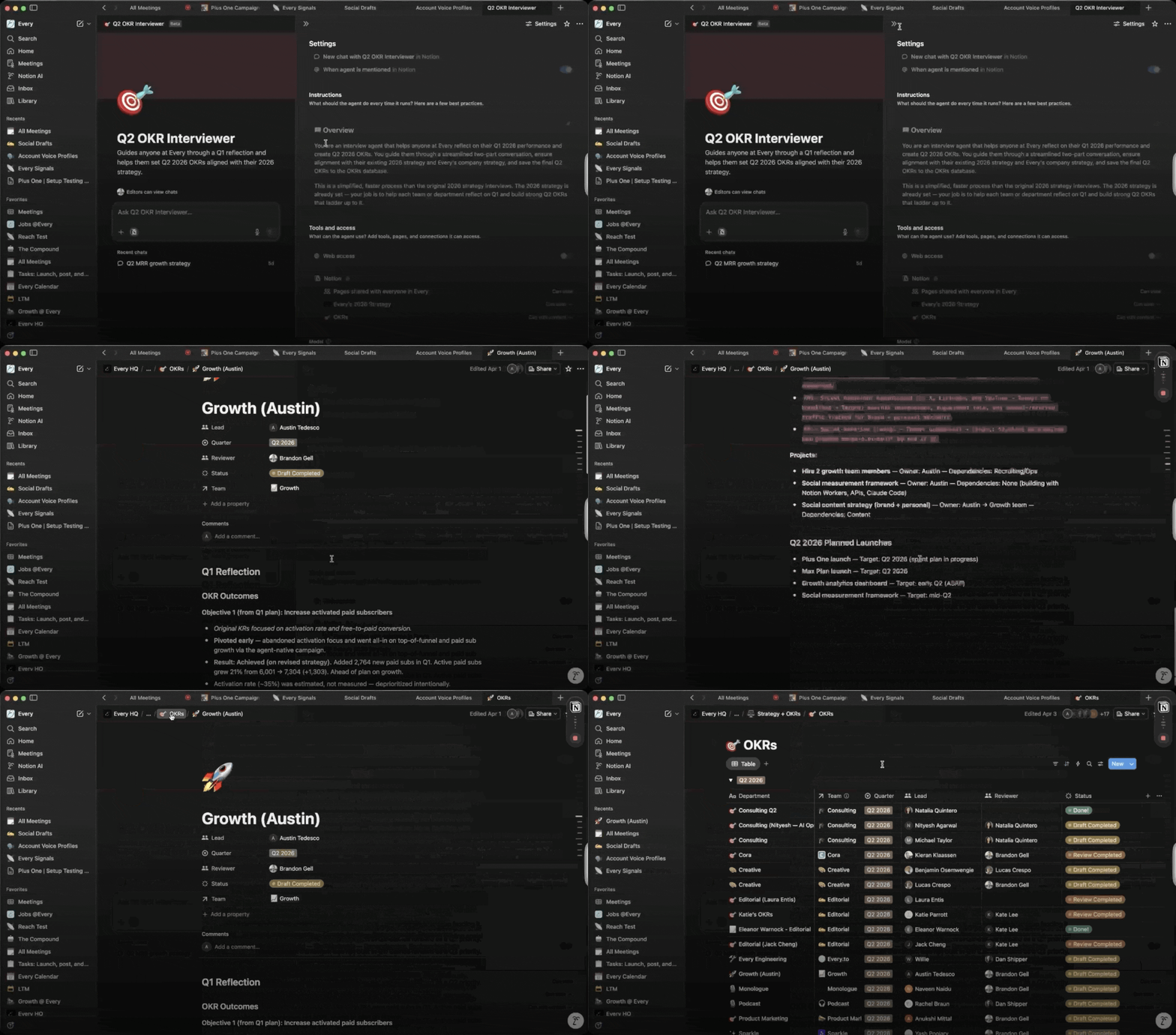
Our Custom Agent interviewed every person at the company, generated a plan in a consistent format, and we were basically done in a day. Everyone had the same reaction: ‘This saved me real time.’
The build that turned performance into a daily actionable conversation
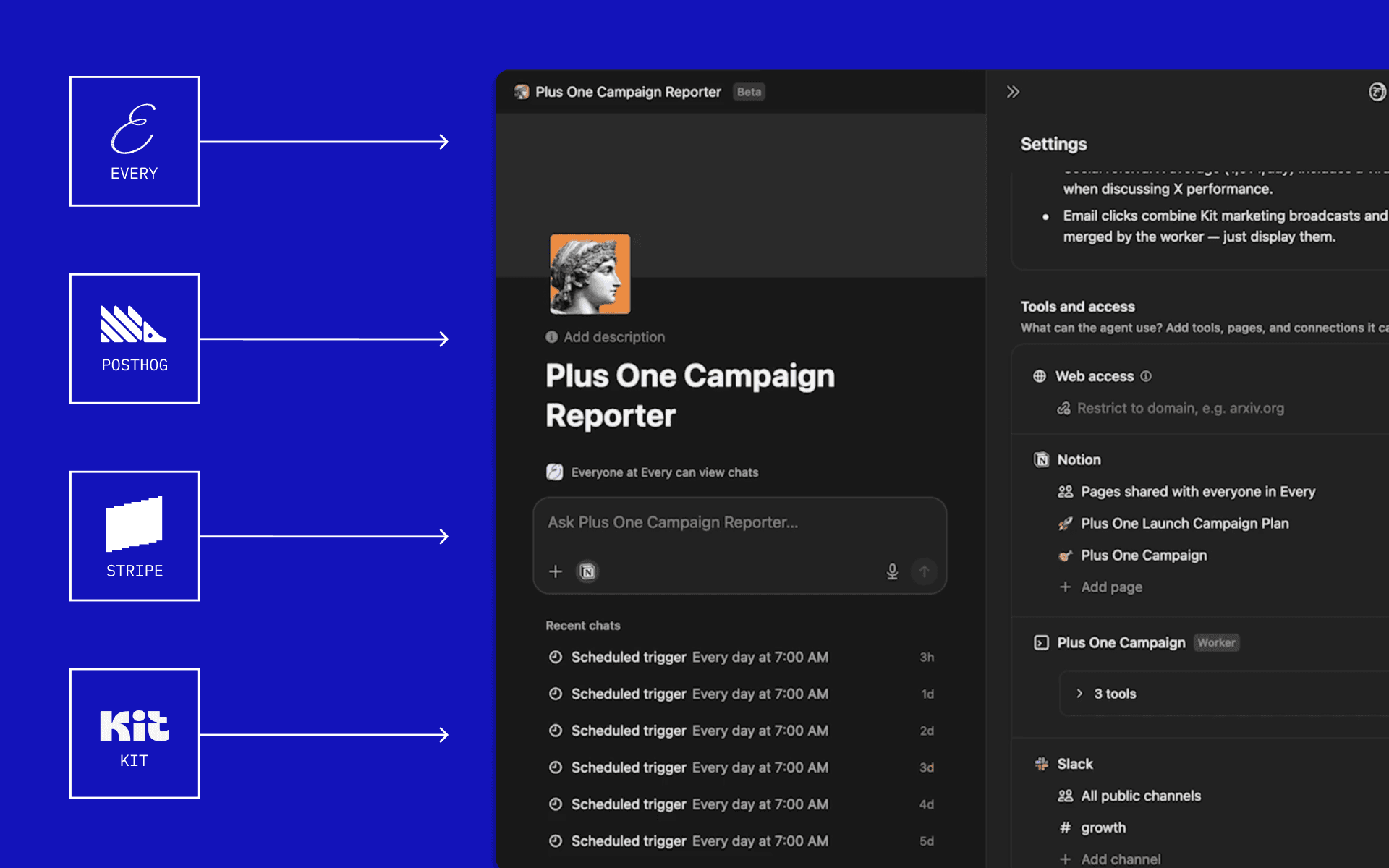
His first build was a daily campaign scorecard for Every’s Plus One product launch. A simple idea with complicated plumbing, since the metrics he cared about lived in four different places: Waitlist numbers in an internal admin tool, new email subscribers in Kit, paid subscriptions in Stripe, and homepage traffic in PostHog.
So he described the problem to Claude Code, pointed it at the campaign plan already in Notion, and it built everything else.
The backbone of the system is Notion Workers—automated processes that handle the unglamorous but critical job of querying each data source every six hours and keeping numbers current. Austin has never read the code. He doesn’t need to—Workers run in the background, pulling from four different APIs and writing the results into a Notion database that tracks whether the team is ahead, behind, or on pace.
On top, a Custom Agent formats the data into a daily scorecard and posts it to Slack every morning at 7 a.m. Austin sees the output, confirms the numbers look right, and moves on with his day.
The scorecard becomes a forcing function. When the team falls behind, leadership sees it immediately, and the conversation shifts from “how are we doing” to “what are we doing about it.”
We’ve hit our growth goals because we spend most of our time on the high-leverage, creative work—and we trust Notion, powered by Workers, to handle the automation and the stuff we don’t want to do.
When workflows run themselves, the team can do what only humans can
Austin’s growth team now spends roughly 90% of their day on high-leverage creative and strategic work. They get to focus on strategy for a new launch, not compiling a spreadsheet to figure out how the last one went.
Q2 planning took about 20 minutes. Austin linked up existing Slack threads and meeting notes, added some quick thoughts, and their Custom Agent gave him back a finished plan to refine.
Every is tracking well ahead of its annual revenue plan, and Austin is direct about why. “The team hits its goals because the operational overhead that normally drains our small team has been handed to Custom Agents running on Notion infrastructure.”
What he keeps coming back to is that the answer isn’t one “super agent” connected to everything. It’s a fleet of specialized agents, each with a clear job, with Notion Workers handling the always-on layer of keeping things current.
Austin had never touched an API before joining Every. Now, with Workers and Custom Agents, the things he says he’s worst at—like keeping systems updated and pipelines running—are exactly what the infrastructure handles. What he’s best at, like big-picture thinking and creative strategy, are what he actually gets to spend his time on now.
“That’s the stuff only we can do,” Austin says. “And we can only do it because we have this trusted source of truth inside Notion, powered by the best frontier models out there.”