When tool shrinking became DANA's growth engine
As Indonesia's largest payment platform scaled to 200 million users, DANA Indonesia needed to solve a critical problem: their engineering team was drowning in tools. By consolidating, automating, and augmenting with AI, they reduced costs by 47%, cut development time by 56%, and proved that the right foundation transforms how AI automates their workflows.
When tool sprawl becomes process debt
Imagine a fancy restaurant where everything seems perfect until you step into the kitchen. Total chaos. Everyone's frantically shouting orders and managing multiple systems and processes for different meal deliveries. That was DANA Indonesia in 2020.
As Indonesia's largest fintech, with 200 million registered users as of 2025, DANA delivered exceptional customer experiences. But behind the scenes, the engineering team drowned in tool sprawl. Separate tools for project management, roadmap planning, training, deployment, quality assurance, and documentation created a fragmented, expensive mess.
Randi Waranugraha, VP of Engineering at DANA, joined as the first founding engineer in 2017. For a company processing payments for millions daily, this wasn't sustainable. They had accumulated this thing called process debt, and like financial debt, it was compounding.
What we had is that it was a total complete mess. Everyone has to manage multiple tools to complete their work. The workflow was broken. The communication was broken.

Building the foundation: One source of truth for 47% cost savings
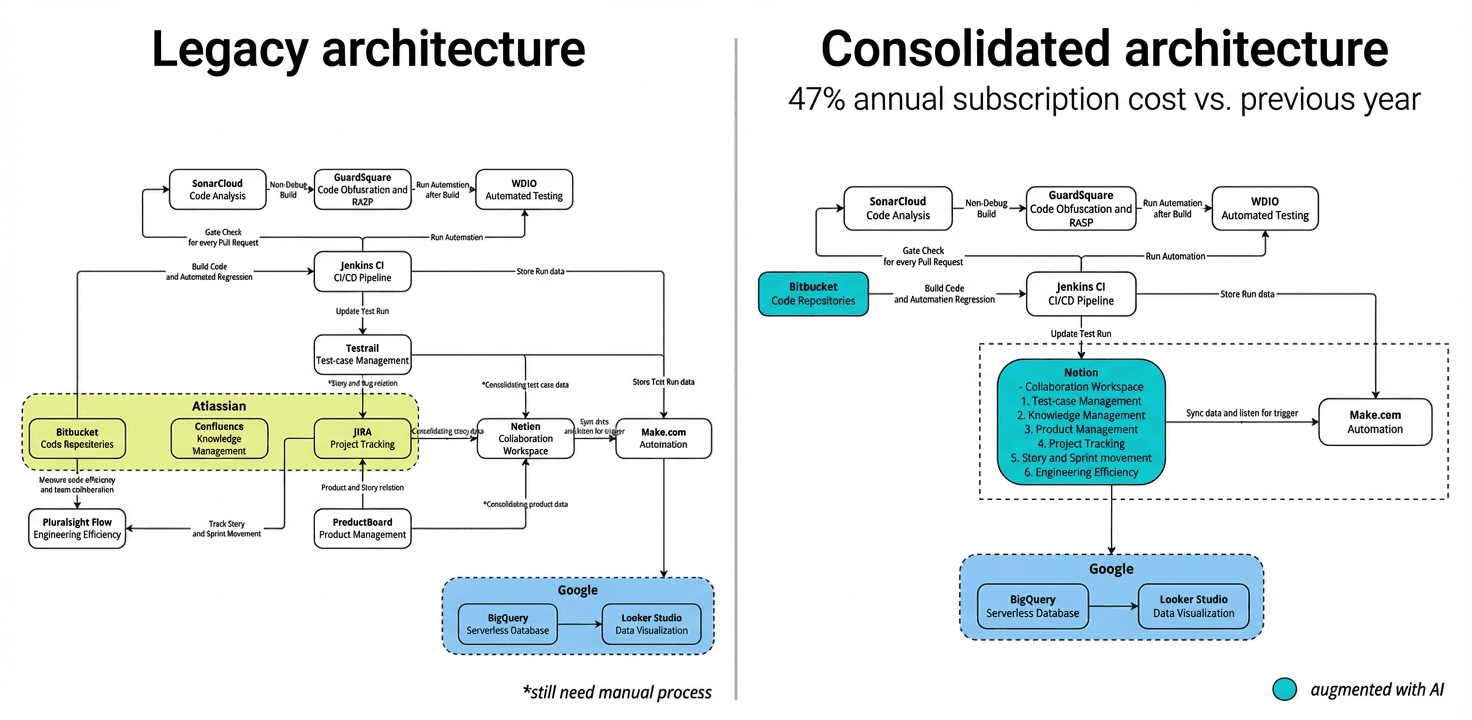
Starting in 2020, DANA migrated to Notion, convincing the first 100 people this was a new way of working. They orchestrated processes using Notion databases and relational structures, migrating data from existing tools whilst maintaining history:
Test case management
Project management
Knowledge management
Product backlog management
Issue tracking
Engineering efficiency workflows
As a result, annual subscription costs dropped 47%. Workflows centralised and Notion became the single source of truth.
DANA adopted a model that gave each squad a dashboard with team members, timelines, backlogs, documentation, tasks, and KPIs. From engineers to executives, everyone had the same picture.
Starting with consolidation first, multiple tools create multiple sources of truth. By bringing work into one connected workspace, DANA reduced cognitive load and created the working foundation for everything that followed.
If it's not in Notion, it doesn't exist," became the team mantra—a forcing function for documentation that scales.
When automation became essential to ship faster
Cost optimisation was a win, but tool consolidation alone had limited impact without fixing workflow inefficiencies.
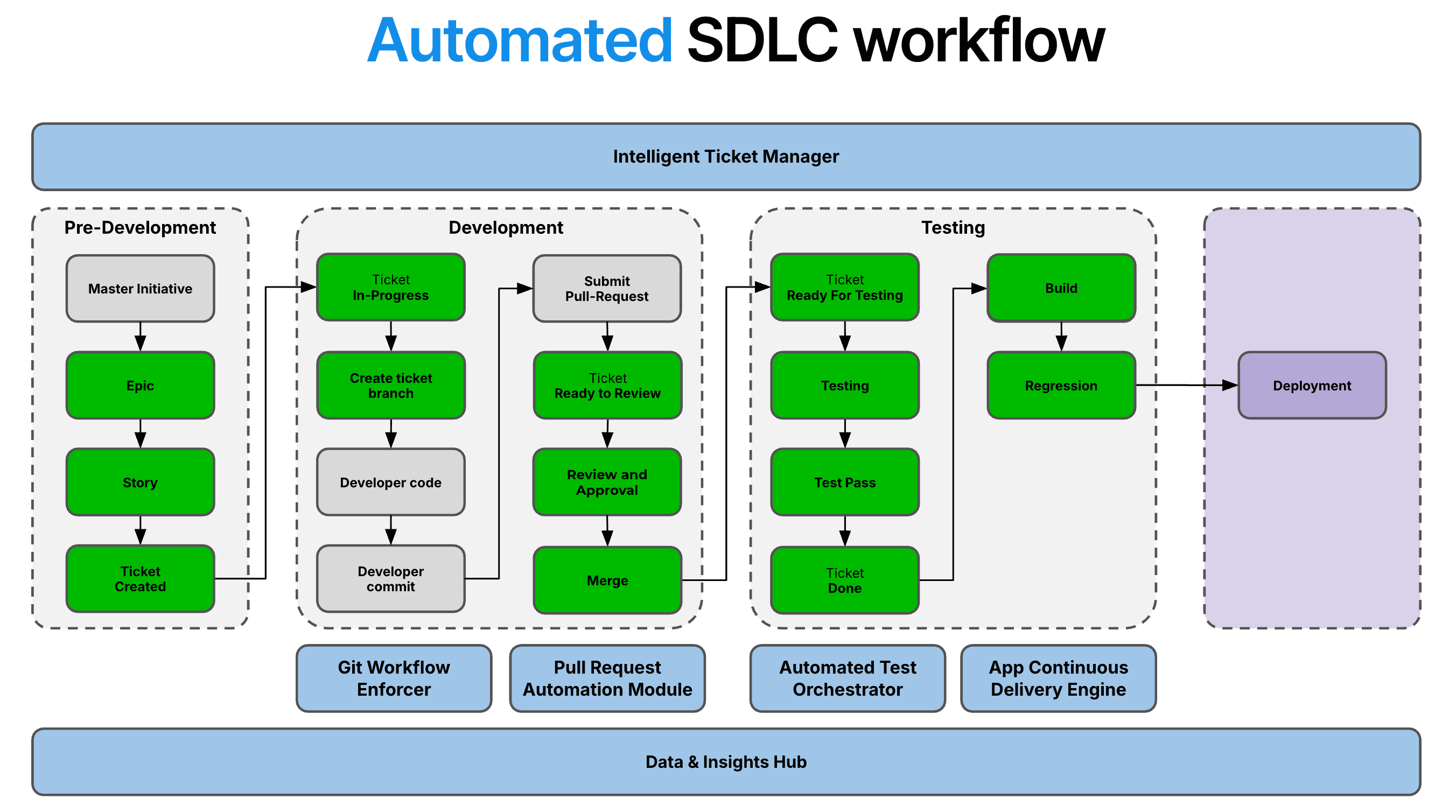
The breakthrough: automation. Randi's team built seven automation modules using Notion Automation, the Notion API, and webhooks:
Intelligent ticket management – Updates statuses based on code progression
Git workflow enforcement – Ensures proper branching
Pull request automation – Enforces reviews and automates merging
Automated test orchestration – Executes tests continuously
App continuous delivery – Streamlines deployment
Data insights hub – Centralises metrics
Proactive alerting – Surfaces issues early
In practice: When a developer moves a ticket to "In Progress," Notion creates a Git branch. Pull requests move tickets to "Code Review." Merged code updates to "Ready for Testing." No manual updates, no forgotten steps, no butterfly effects.
The results:
Cycle time improved 37% to 4.3 days per task
Epics delivered increased 66.4%
9.9 tasks per headcount per sprint
84 app submissions annually—more than one per week
Once processes are centralised, repetitive manual work becomes visible. DANA focused automation on the biggest bottlenecks, creating reliable, consistent execution.
Next, doubling velocity with AI
How do you deliver more without compromising gains?
The answer: AI—but not for its own sake. DANA had centralised knowledge and automated processes. This created the foundation for AI to make smarter decisions.
"Centralise. Automate. Decide," Randi explains. "We centralised our knowledge in Notion, our design system in Figma, our code base in single instances. Then automated workflows. Now AI makes intelligent decisions with the right context."
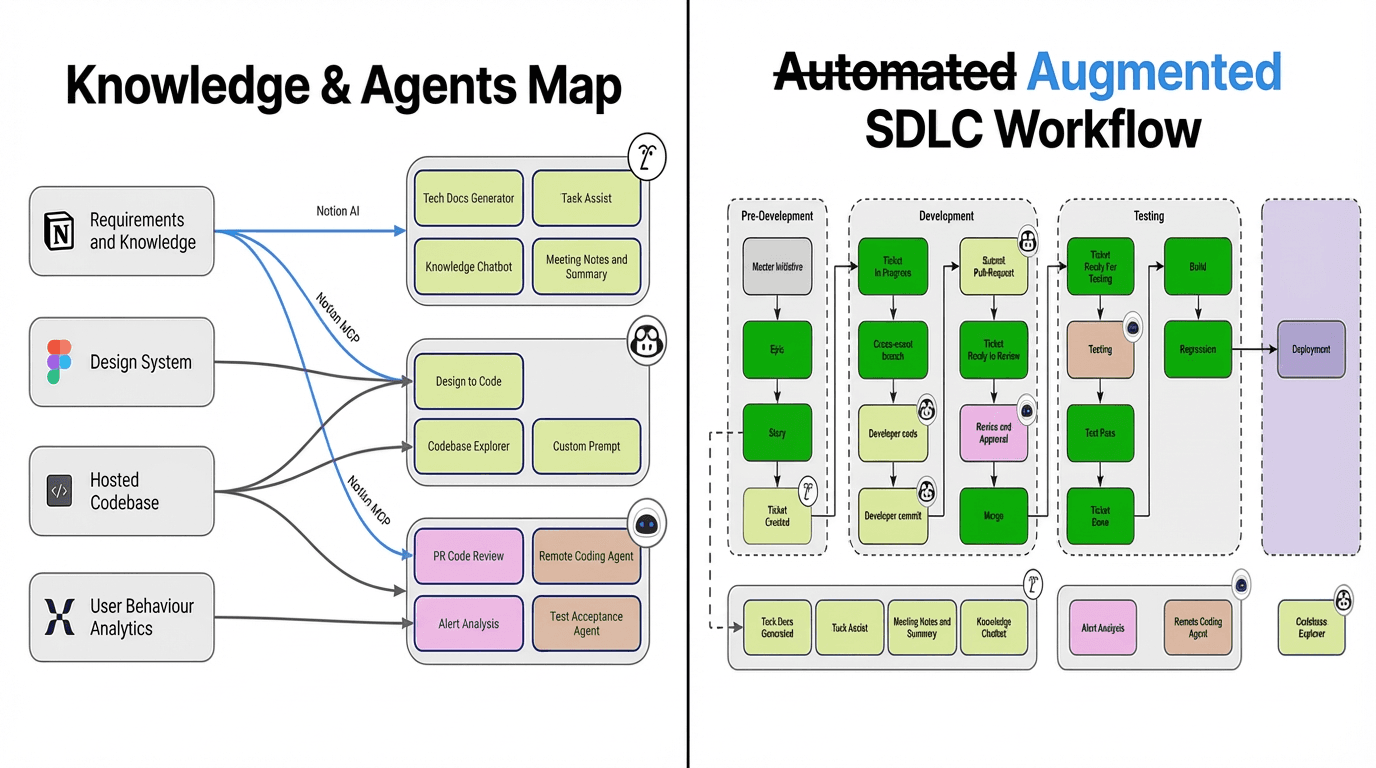
DANA uses Notion AI for documentation, task assistance, knowledge search, and meeting summaries. But they went further, building agents connecting Notion knowledge with their design system and code base:
Design-to-code generation – Agents take Figma designs, pull Notion context and code base patterns, then generate production-ready code
Remote coding agents – These agents handle a range of code tasks—from bug fixes and feature development to refactoring—by drawing on DANA's centralised knowledge base, design system patterns, and codebase conventions. Rather than treating each task in isolation, the agents understand project context, architectural decisions, and team standards, allowing them to write code that aligns with existing systems and quality standards.
Randi's team has taken personalisation further by creating custom AI teammates. One example is his "Chief", an AI teammate configured to search only subtasks when asked about pending tasks. This focused training enables faster, more accurate queries. The team shares these agent configurations with one another, allowing everyone to benefit from optimised workflows tailored to specific needs.
The results have now improved by layering in AI:
Cycle time: 1.9 days—more than half the automated baseline
13 tasks per headcount per sprint
81% monthly AI active users
AI handles previously manual work, freeing teams for creative ideation
Build the foundation before adding AI. AI outputs match the systems and context you provide. DANA's centralised knowledge and automated processes made AI transformative. They optimised cost first, improved time second, then augmented with AI third. Each phase built on the last.
We're very excited to see what Custom Agents will enable in productivity. When you centralise knowledge, automate processes, and let AI make decisions with that context, you move from faster execution to smarter execution.
Building for what's next
From that chaotic kitchen in 2020 to a streamlined, AI-augmented operation today, DANA has fundamentally transformed how they build software. They've proven you don't have to choose between speed and quality, scale and control, cost and capability.
"Today's achievement is tomorrow's expectations," Randi reflects. "We beat our first challenge and optimised cost. Beat the second and improved time. Now we're using AI to deliver more without compromising those gains. And we're just getting started."